Art Beyond Boundaries 2026: Tohun Kobayashi's Live Sumi-e of Mount Fuji and Pine
Tohun Kobayashi painted pine, Mount Fuji and the moon live on a folding screen at the Art Beyond Boundaries 2026 awards in Tokyo. Follow it chapter by chapter.
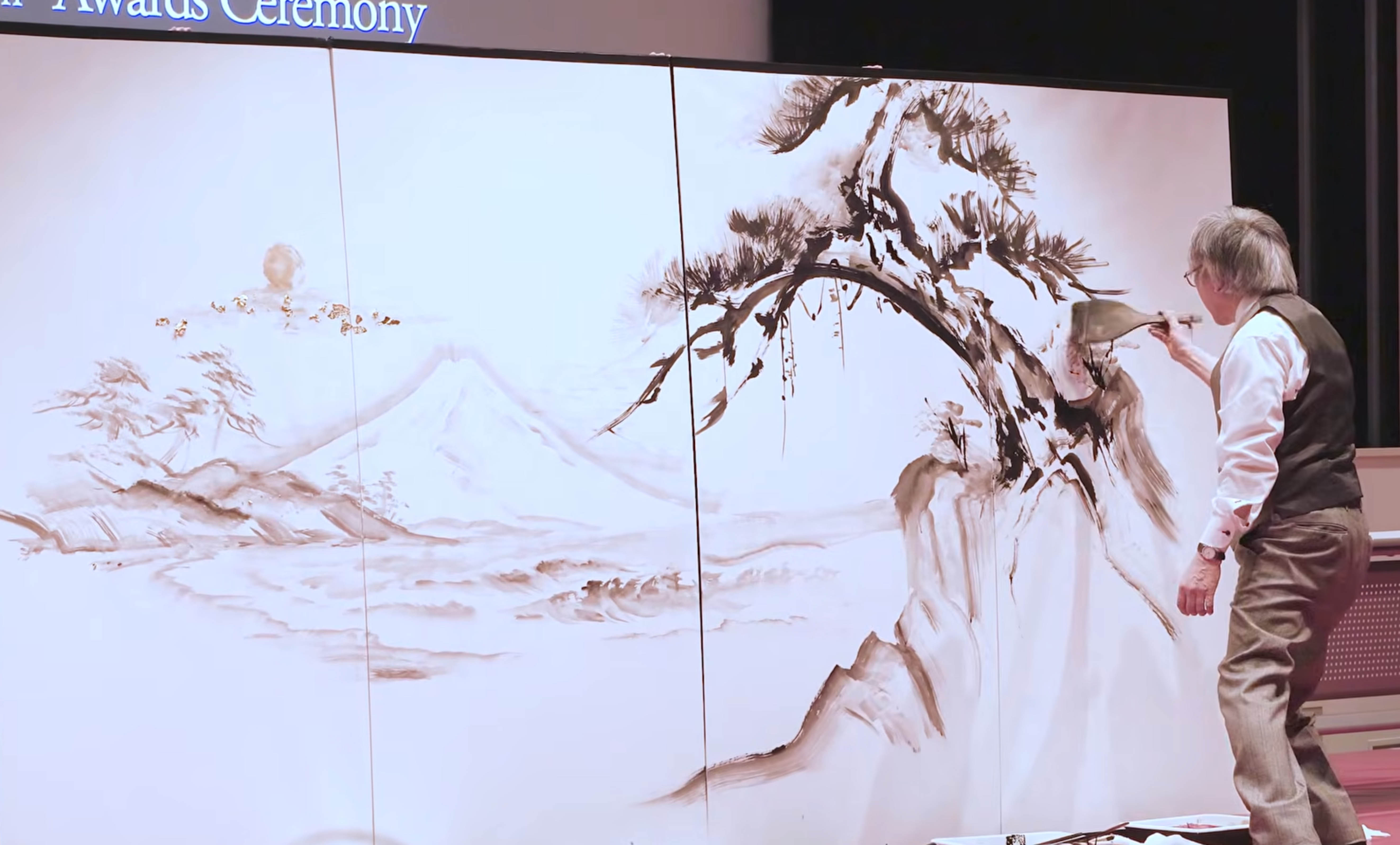
On 31 January 2026, at the awards ceremony of Art Beyond Boundaries 2026 at The National Art Center, Tokyo, Tohun Kobayashi, president of the International Association of SUMI, which organises the exhibition, painted a sumi-e landscape live. A guest ambassador made the first stroke. Tohun Kobayashi then painted pine, rocks, water, distant trees, Mount Fuji and the moon on a large white folding screen, and finished with his rakkan, the artist's signature and seal.
The whole process has been published as a video of 15 minutes and 46 seconds on the Kokusai Bokuyukai (International Association of SUMI) YouTube channel. This article introduces the exhibition and follows the painting through the video's chapters.
In this article:
- How the landscape painted at the ceremony is composed
- The dates, venue and organiser of Art Beyond Boundaries 2026
- The painting process, chapter by chapter
- What to watch: dark in front, pale behind
The Landscape Painted at the Art Beyond Boundaries 2026 Awards Ceremony
Sansuiga, literally "mountain and water painting", is the landscape tradition of East Asian painting (JAANUS). The landscape painted live has a large pine and rocks in the right foreground, water across the middle, a strip of land with small trees in the far left, Mount Fuji in the centre and the moon in the upper left. The rakkan goes in at the upper left at the very end.
It was painted on a large white folding screen, a byōbu, standing on the stage and taller than a person. The branches of the pine reach out across the screen.
What Is Art Beyond Boundaries?
Art Beyond Boundaries, known in Japanese as Bi wa Kokkyō o Koete ("Beauty Beyond Borders"), is an international open exhibition organised by the International Association of SUMI. The 2026 exhibition was the 23rd.
| Art Beyond Boundaries 2026 | |
|---|---|
| Japanese name | 美は国境を越えて 2026 |
| Edition | 23rd |
| Dates | 22 January – 1 February 2026 |
| Venue | The National Art Center, Tokyo, Room 2A (7-22-2 Roppongi, Minato-ku, Tokyo) |
| Organiser | International Association of SUMI (Kokusai Bokuyukai) |
| Genres | Sumi-e, calligraphy, painting based on sumi-e, photography and digital prints (The National Art Center, Tokyo, Art Commons, in Japanese) |
| Participation | 36 countries (official website) |
The official website describes an exhibition that brings together painting, calligraphy, video and sculpture from artists in 36 countries, united by a shared love of Japan and its artistic traditions. The official catalogue of the 2026 exhibition can be downloaded free of charge from the site (Art Beyond Boundaries official website).
On his own website, Tohun Kobayashi explains that the exhibition began as a show centred on sumi-e. As its circle widened, works began to arrive across genres and national borders, and it now receives entries from Europe as well as from Asia and the Pacific (Tohun Kobayashi's website, in Japanese).
The Live Painting | It Began with an Ambassador's First Stroke
The live painting took place at the awards ceremony held on 31 January 2026, near the end of the exhibition (report by E.N.International, in Japanese). The venue was The National Art Center, Tokyo, where the exhibition itself was held. The screen behind the stage read "International Association of SUMI Awards Ceremony".
According to the video's chapters, the painting begins with the ambassador's first stroke. A guest ambassador and Tohun Kobayashi stand side by side in front of the screen, and the ambassador lays down the first brushstroke. Tohun Kobayashi then pulls the trunk of the pine in a great arc from the upper right of the screen.
As you watch, follow the painting as it moves from the pine and rocks in front to Mount Fuji and the moon behind, with the ink changing tone as it goes. From the first stroke to the rakkan, the whole process fits into 15 minutes and 46 seconds.
How the Painting Unfolds | Following the Video Chapters
The video description lists nine chapters, so you can jump straight to any stage.
| Time | Chapter |
|---|---|
| 00:00 | Start: the ambassador's first stroke |
| 00:43 | Painting the pine |
| 01:30 | Painting the pine needles |
| 03:12 | Painting the rocks |
| 05:33 | Painting the background |
| 08:00 | Painting the distant view |
| 10:21 | Painting the mountain in the background |
| 12:02 | Painting the moon |
| 15:33 | Signature |
(Chapter titles translated from the Japanese video description.)
Read in order, the chapters show the painting moving from the foreground of pine and rocks to the background, the far distance, Mount Fuji and the moon: from front to back.
Foreground: pine and rocks
The pine begins with a trunk that arcs in from the upper right of the screen. After needles are layered at the ends of the branches, rocks, a cliff, are painted beneath the pine. Both are in thick strokes of dark ink. Going by the chapter times, about five minutes, from 00:43 to 05:33, are given to this foreground.
Middle and far distance: water and trees
In the background chapter (from 05:33), horizontal strokes across the middle of the picture form the water. In the distant view (from 08:00), a strip of land with small trees is added far to the left. Both are drawn in thinner lines of paler ink than the foreground.
Mount Fuji, the moon and the rakkan
In the chapter on the mountain in the background (from 10:21), Mount Fuji appears in the centre of the picture. The moon (from 12:02) is placed in the upper left. In the final chapter (from 15:33), the rakkan, the artist's signature and seal added at the edge of a finished painting (JAANUS), goes in at the upper left.
What to Watch | Dark in Front, Pale Behind
Landscape painting creates depth by distinguishing the foreground, the middle ground and the far distance. In this live painting, too, the pine and rocks in front are in thick strokes of dark ink, while the distant trees and Mount Fuji in the centre are in thin lines of pale ink. The video lets you follow, from start to finish, how the tone of the ink and the weight of the line change as the painting moves from front to back.
The other thing to watch is the scale. Facing a screen taller than himself, Tohun Kobayashi stands and draws with his whole arm, and for the lower parts of the screen he crouches or kneels. He also switches between large and small brushes. This is a different kind of painting from work on paper at a desk: the whole body is involved.
More from Art Beyond Boundaries
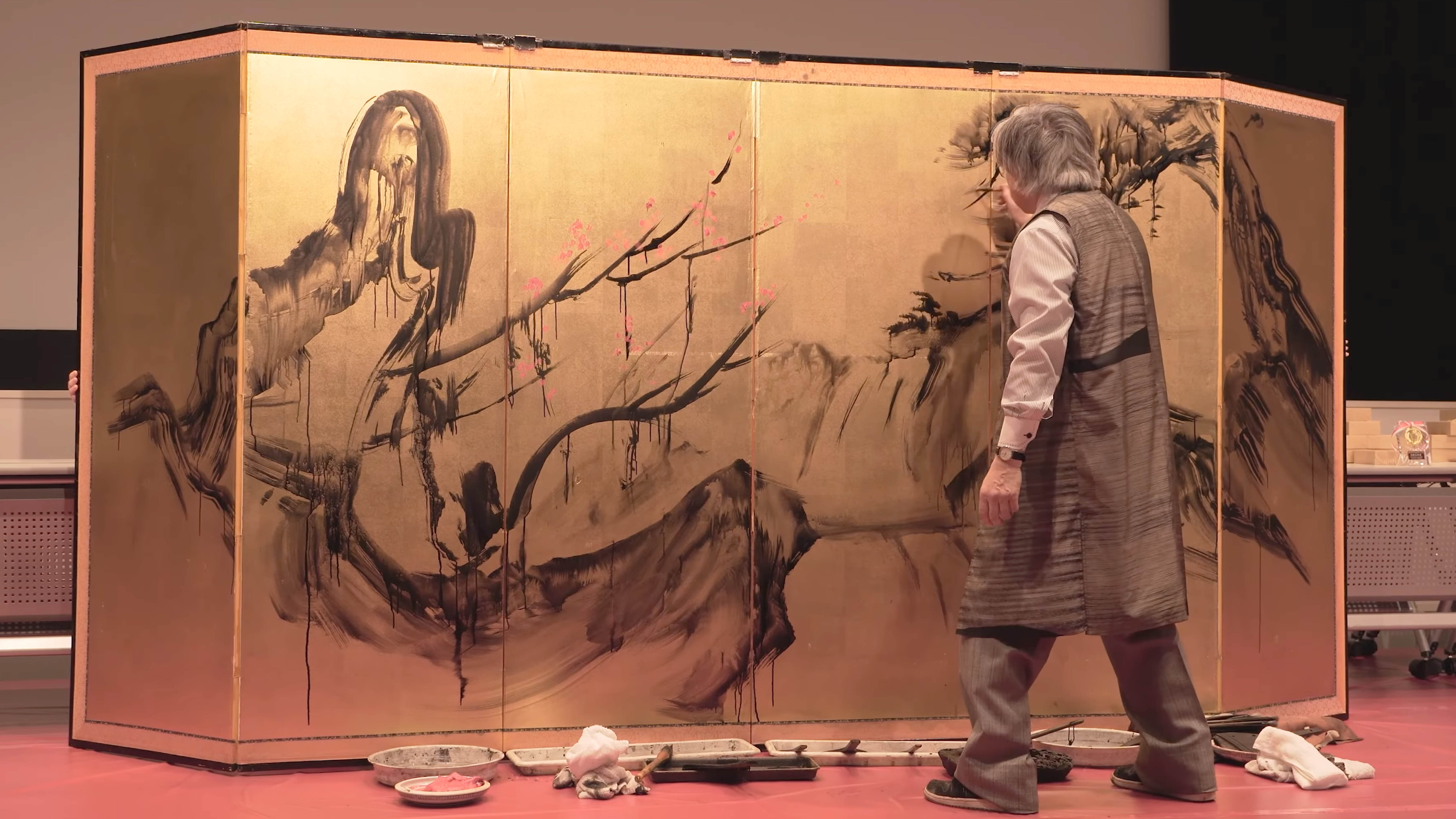
Tohun Kobayashi also painted live at the awards ceremony of the previous year's exhibition, Art Beyond Boundaries 2025, on a gold folding screen. See Art Beyond Boundaries 2025: plum and pine on a gold folding screen.
In April 2026, an exhibition bearing the Art Beyond Boundaries name was also held in Borja, Spain. We reported on it in Sumi-e in Spain: inside the 2026 Borja exhibition.
Works by Tohun Kobayashi and Tohsei Kobayashi are featured in our exhibition report Yin Yang in Japanese ink painting.
Frequently Asked Questions
When and where was Art Beyond Boundaries 2026 held?
It was held from 22 January to 1 February 2026 at The National Art Center, Tokyo (Room 2A) in Roppongi. It was organised by the International Association of SUMI and was the 23rd edition.
When did Tohun Kobayashi's live painting take place?
On 31 January 2026, at the awards ceremony held at The National Art Center, Tokyo. The screen behind the stage read "International Association of SUMI Awards Ceremony".
What did he paint?
A sansuiga landscape. A guest ambassador made the first stroke on a large white folding screen, and Tohun Kobayashi painted pine, rocks, water, distant trees, Mount Fuji and the moon, finishing with his rakkan.
How long is the video?
It runs for 15 minutes and 46 seconds. The description lists nine chapters, so you can start from any stage.
What kinds of work are shown at Art Beyond Boundaries?
According to The National Art Center, Tokyo, the genres are sumi-e, calligraphy, painting based on sumi-e, photography and digital prints. The official website describes painting, calligraphy, video and sculpture from artists in 36 countries.
Was there a live painting in 2025 as well?
Yes. Tohun Kobayashi also painted live at the awards ceremony of Art Beyond Boundaries 2025, on a gold folding screen.
Summary
- On 31 January 2026, at the awards ceremony of Art Beyond Boundaries 2026 (The National Art Center, Tokyo, 22 January – 1 February, organised by the International Association of SUMI), Tohun Kobayashi painted a landscape live.
- It began with a guest ambassador's first stroke. Pine, rocks, water, distant trees, Mount Fuji and the moon followed on a large white folding screen, finished with the rakkan. The video runs for 15 minutes 46 seconds, with nine chapters.
- Dark and thick in front, pale and thin behind: the basics of landscape painting, played out on a screen taller than the painter.
Use the chapters to start from whichever stage interests you most.
Jin is a sumi-e artist and calligrapher whose practice brings Western calligraphy into dialogue with the Japanese tradition of ink painting. In Jin's work, letterforms, brushed lines, and ma — the resonant negative space at the heart of sumi-e — come together in compositions that speak across cultures. This East–West synthesis grounds an ongoing exploration of artistic possibilities that reach beyond cultural boundaries. Jin currently serves as a Director of the International Association of SUMI, and was recently honored with the Special Jury Award — the Arisumi Mitamura Prize — at Art Beyond Boundaries. Rooted in tradition yet attentive to the present, Jin continues to share a contemporary vision of sumi-e with audiences around the world.
RelatedArticle
What Is Mokkotsu? The Boneless Technique and How It Differs from Kōroku
Art Beyond Boundaries 2025: A Live Sumi-e of Plum and Pine on a Gold Folding Screen