How to paint a sheep in sumi-e for the 2027 Year of the Sheep (Goat), following Tohun Kobayashi's demonstration from the muzzle and horn to the inscription.
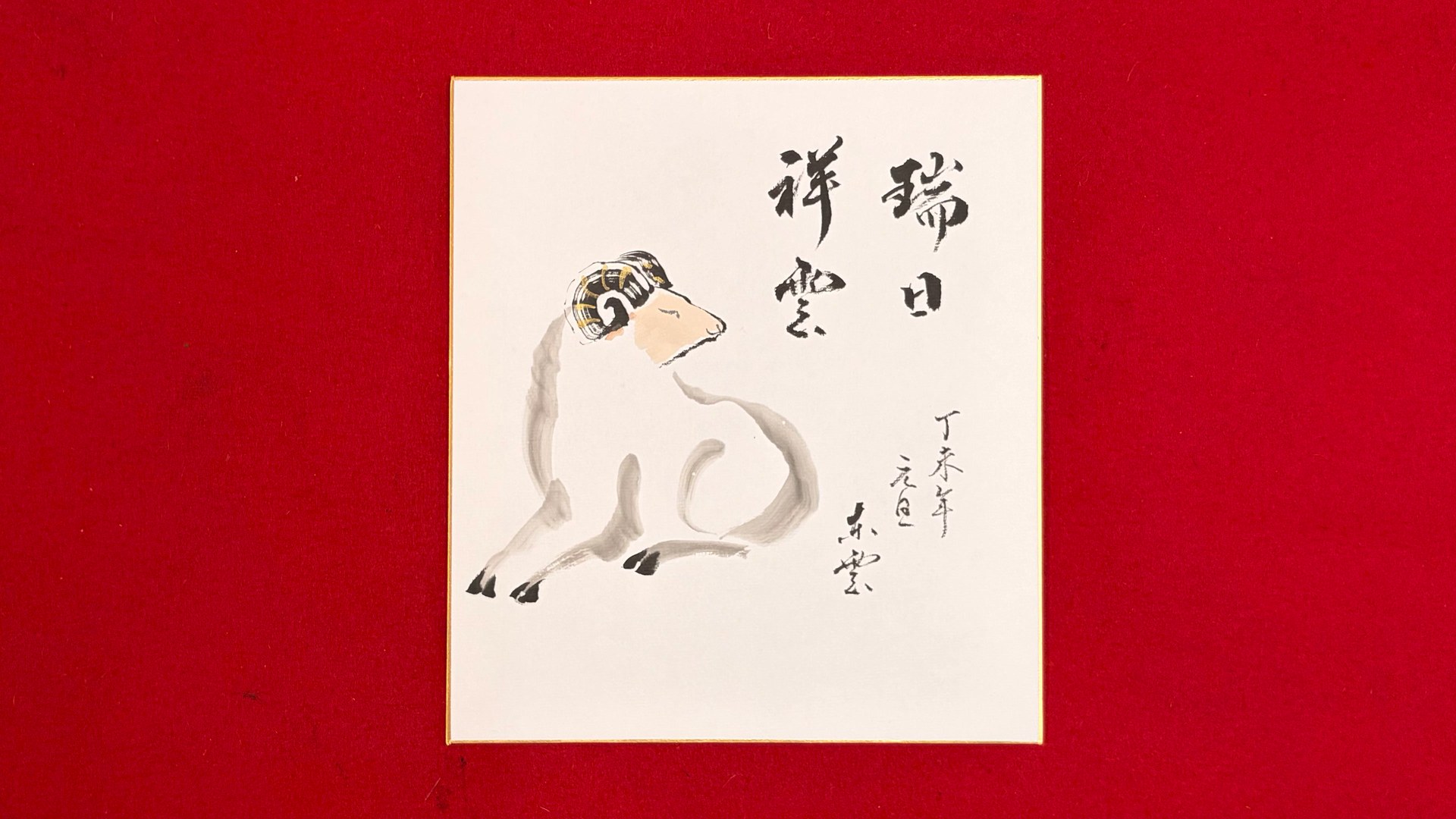
To paint a sheep in sumi-e, start with the line of the muzzle, sweep the horn in a single spiral with the brush hairs spread open, and draw the body and legs in broad lines of pale ink. Firm up only the hooves in dark ink, add pale brown to the face and gold to the horn, and finish with an inscription and the date. This guide follows a 1 minute 56 second demonstration in which Tohun Kobayashi of Kokusai Bokuyukai paints the zodiac sheep for 2027 on a shikishi, a square board of thick card, and explains each stroke in the order he paints it.
Is 2027 the Year of the Sheep or the Year of the Goat? Both names are used in English, because the Chinese word for the eighth animal of the zodiac, yáng, covers both sheep and goats (Wikipedia, Goat (zodiac)). In Japan the sign is hitsuji, the sheep, and that is what Tohun Kobayashi paints: a sheep with a curling horn and white wool. In the Chinese lunar calendar, the new year begins on Saturday 6 February 2027 (Hong Kong Observatory).
What you will learn:
- The order of strokes for a sheep, starting from the line of the muzzle
- How to sweep the horn in one spiral with the brush hairs spread open, leaving kasure (white streaks where the paper shows through)
- How broad lines of pale ink suggest a sheep's wool
- What the inscription zuijitsu shōun and the date line mean
- How to fit the same composition on a New Year card, and when the Year of the Sheep begins
How to Use This Guide | Watch the 1:56 Demonstration Alongside the Steps
The order of painting
In this video from Kokusai Bokuyukai, Tohun Kobayashi paints the sheep for 2027 on a single shikishi board. The camera looks straight down and never moves, so you can follow every stage, from the first stroke to the inscription, the date and the signature. The video has no chapters, so the table below marks the stages as they appear on screen. The times are approximate.
| Starts at | Stage | Section of this guide |
|---|---|---|
| 0:00 | Face, beginning with the line of the muzzle | Step 1 |
| 0:23 | Horn | Step 2 |
| 0:36 | Body and legs | Step 3 |
| 0:53 | Hooves | Step 4 |
| 1:00 | Colour: pale brown on the face, gold in the horn | Step 5 |
| 1:14 | Inscription: zuijitsu shōun | Step 6 |
| 1:37 | Date line and signature | Step 6 |
| 1:52 | The finished work | Putting It All Together |
The demonstration
Four things are worth watching for:
- The horn is swept in one spiral with the brush hairs spread open, leaving kasure
- The body is drawn with broad lines of pale ink that suggest the fullness of the wool
- The hooves are dark; pale brown goes on the face and gold in the horn
- The inscription and the date line finish the painting
Watch it once from beginning to end to see the whole flow, then go back to the time given in each step's heading and compare the stroke with the notes below. The video is under two minutes long, so watching it a few times before you pick up the brush makes it easier to learn the order of the lines and where each one goes.
Before You Paint | A Shikishi Board, Ink and Two Colours
What is a shikishi?
Tohun Kobayashi paints on a white shikishi. A shikishi is a square board of thick card made for writing poems or for painting, and today the usual size is 27.3 by 24.2 centimetres, according to the Japanese encyclopaedia Nihon Daihyakka Zensho (Nipponica).
If you are painting a New Year card, a postcard works too. The section on cards below shows how to fit the same composition on one.
Ink and colour: pale brown and gold only
The ink is used in two tones, dark and pale. In the finished sheep, the lines of the face, the horn and the hooves are dark, and the body is pale. For sumi-e, the ink comes from an ink stick ground on an inkstone; our guide to sumi-e tools and supplies introduces the brush, ink stick, inkstone and paper.
The colour is limited to two: pale brown for the face and gold for the horn. The body has no colour at all and is painted in ink alone. On screen, dishes of ink and colour sit to the right of the board.
Steps 1 and 2 — Face and Horn | Start at the Muzzle, Sweep the Spiral (0:00 / 0:23)
Face: begin with the line of the muzzle (0:00)
The first stroke in the video is the line of the sheep's muzzle. A line drawn to the right from around the brow folds back in a small turn at the tip of the muzzle and returns towards the mouth. A single shape, like a sideways V pointing to the right, sits in the middle of the board, and the sheep's face begins from it.

Next come a short line for the eye and a line under the jaw. The eye is a single thin line, as if it were closed, which gives the sheep a calm expression.
Drawing the line of the muzzle decides which way the face looks. This sheep faces right, and in the finished work the inscription sits at upper right, where the sheep is looking. The first stroke sets the direction of the whole painting.
Horn: one spiral with the brush hairs spread open (0:23)
With the face done, Tohun Kobayashi reloads the brush with ink and paints the horn to the left of the face, at the back of the head. He sweeps the horn in a single spiral with the brush hairs spread open and leaves kasure in it, the white streaks where the paper shows through a stroke.
On screen, the line of the horn is full of these white streaks. With less water in the brush, the white of the paper shows through the line in fine threads, and that gives the curled horn its hardness. Because the spiral is drawn in one movement, the streaks run on along the curve. Besides the spiral, he adds a short arc above the head.
You can practise the amount of water that produces kasure with the drills in Sumi-e Brush Strokes and Techniques.
Steps 3 and 4 — Body, Legs and Hooves | Broad Pale Lines, Dark Hooves (0:36 / 0:53)
Body and legs: broad lines of pale ink (0:36)
The body is drawn with broad lines of pale ink.
In the video, Tohun Kobayashi first draws a long line from under the horn down to the lower left, then a line from under the jaw that sweeps out to the right in a wide arc and comes down. He then adds short lines inside to make the legs. The front legs stretch towards the lower left and the hind legs look folded: the sheep is sitting, or lying down.

The thing to watch is the space between the lines. The inside of the body is not filled in: the white of the paper is left, and the outline is not fully closed. The white that remains reads as the sheep's white wool. Within a single line of the body there are darker and paler parts, and these suggest the fullness of the wool and the roundness of the body.
Hooves: dark ink only at the tips of the legs (0:53)
At the tips of the legs, short touches of dark ink make the hooves.
Within the pale body, the darkest marks are the lines of the face, the horn and the hooves. Because the dark ink gathers at the head and at the ends of the legs, the pale body does not look vague, and the whole painting holds together.
Steps 5 and 6 — Colour, Inscription and Date | Pale Brown, Gold and a New Year Phrase (1:00 / 1:14 / 1:37)
Adding colour: the face and horn only (1:00)
Once the sheep is finished in ink, the colour goes on. Pale brown, prepared in a dish, is laid over the face, and gold goes into the streaks of the horn. Only the face and the horn are coloured; the body stays in ink.
With the colour kept to two, the tones of the ink remain the heart of the painting, and only the face and the horn look soft and bright.

The inscription: zuijitsu shōun (1:14)
Words written on a painting, such as a phrase or a poem, are called gasan, or san for short: an inscription. In China and Japan, calligraphy and painting have long been seen as one art, as Nipponica notes.
The inscription on this painting is zuijitsu shōun. It is written large at upper right, in two columns: zuijitsu on the right and shōun on the left. It is a New Year phrase that describes auspicious sunlight and clouds.
A related word, zuiun, is a cloud that appears as an omen of something happy, according to the Japanese dictionary Digital Daijisen. The character shō means good fortune, auspiciousness or a good omen, and the part of the character that gives its sound, its phonetic, is the sheep, according to the character dictionary Fukyūban Jitsū. So the word shōun, written beside the sheep, has a sheep inside it too.
The date line and signature (1:37)
Below the inscription, he writes the year and the day: the year hinoto-hitsuji in the right column and gantan in the left. Hinoto-hitsuji is the zodiac name of 2027. Gantan is the morning of New Year's Day, 1 January, as the Japanese dictionaries on Kotobank define it. Last, he signs his name, Tohun, below and to the left of the date line.
In the finished work, the sheep sits at lower left and the words at upper right, with empty space between them. Because the words lie in the direction the sheep is facing, the sheep almost seems to be looking at the New Year phrase.
Painting the Sheep for a New Year Card | Composition, and When the Year Begins
Composition on a small card
The composition of the finished work also suits a New Year card. Put the sheep at lower left and the words at upper right, leave space between them, and the writing and the picture will not overlap.
A postcard is much smaller than a shikishi, so it helps to keep the words short. If you want all four characters of the inscription, paint the sheep a little smaller and decide where the writing will go before you start, so that the space does not run out. Before the card itself, paint a few versions on practice washi to get used to the order of the lines.
When the Year of the Sheep begins
In the Chinese lunar calendar, the first day of the first month of 2027, Lunar New Year, falls on Saturday 6 February 2027. The conversion table of the Hong Kong Observatory names the year Ding-wei, the year of the Goat. In Japan, the New Year begins on 1 January, and this painting is dated gantan, New Year's Day.
If you send New Year cards (nengajō) within Japan, Japan Post starts accepting 2027 cards on 20 December 2026, and to have them delivered on New Year's Day it suggests posting them by 27 December (Japan Post, 31 August 2026, in Japanese). Leave time to paint a few and choose the best.
The sheep in the zodiac
The zodiac (eto) combines the ten heavenly stems and the twelve earthly branches into sixty pairs, from kinoe-ne to mizunoto-i (Digital Daijisen). The year 2027 joins the stem hinoto with the branch hitsuji: hinoto-hitsuji. Assigning animals to the twelve branches dates from the Later Han dynasty in China onwards, according to Fukyūban Jitsū on the same page. Hitsuji is the eighth of the twelve branches, and its animal is the sheep (Nipponica).
The Chinese word for the eighth animal, yáng, covers both sheep and goats; a goat is shānyáng and a sheep is miányáng. That is why the same year appears in English as the Year of the Sheep, the Year of the Goat and sometimes the Year of the Ram (Wikipedia).
Putting It All Together
In his demonstration, Tohun Kobayashi paints the sheep in this order:
- Face: start with the line of the muzzle and set the direction of the face
- Horn: sweep one spiral with the brush hairs spread open, leaving kasure
- Body and legs: broad lines of pale ink, with white paper left between them
- Hooves: dark ink only at the tips of the legs
- Colour: pale brown on the face and gold in the horn, nothing else
- Inscription and date: zuijitsu shōun at upper right, with the date line and signature below
Dark ink for the face lines, horn and hooves against pale ink for the body; a horn swept with the brush hairs spread open against the broad, pale lines of the body. These contrasts are what make this sheep. Watch the video, paint just the face and horn a few times, and then paint the whole sheep from start to finish; the flow of the painting comes more easily that way. If you would like to begin with the basics, Sumi-e for Beginners covers the first steps in Japanese ink painting, and How to Paint Chrysanthemums is another guide that ends with an inscription.
Frequently Asked Questions
How do you paint a sheep's horns in sumi-e?
Sweep the horn in one spiral without stopping, and leave the kasure. In Tohun Kobayashi's demonstration, the spiral horn is painted at the back of the head after the face (from 0:23 in the video). With less water in the brush and the brush hairs spread open, white streaks of paper show through the line of the horn.
How do you show a sheep's fluffy wool in ink?
Use broad lines of pale ink. Leave the inside of the body unpainted, so that the white of the paper shows, and do not close the outline completely. The white that remains reads as the sheep's wool, and the darker and paler parts within each line give the body its roundness.
Where should I start when painting a sheep?
Start with the line of the muzzle. The first stroke in the demonstration runs from the brow to the tip of the muzzle and folds back towards the mouth. Once the direction of the face is fixed, it is easier to decide where the horn and the body should go.
Is 2027 the Year of the Sheep or the Year of the Goat?
Both names are used. The Chinese word for the eighth zodiac animal, yáng, covers both sheep and goats, so in English you will see the Year of the Sheep, the Year of the Goat and sometimes the Year of the Ram. In Japan the sign is hitsuji, the sheep. 2027 is the year hinoto-hitsuji, or Ding-wei in Chinese.
When does the Year of the Sheep begin?
In the Chinese lunar calendar, Lunar New Year falls on Saturday 6 February 2027, according to the Hong Kong Observatory, which names it the year of the Goat. In Japan the New Year begins on 1 January, and this painting is dated gantan, New Year's Day.
What does the inscription zuijitsu shōun mean?
It is a New Year phrase that describes auspicious sunlight and clouds. The related word zuiun is a cloud that appears as an omen of something happy, and the character shō means good fortune, auspiciousness or a good omen.
Why is the sheep an auspicious subject?
One reason lies in the writing. The character shō, meaning good fortune or a good omen, takes the sheep as the part that gives its sound, according to Fukyūban Jitsū. This painting, too, pairs the sheep with the word shōun.
What does gantan mean in the date line?
Gantan is the morning of New Year's Day; some dictionaries also give New Year's Day itself as a meaning. On this painting, the date line sets gantan beside the name of the year, hinoto-hitsuji.
Can I paint it without a shikishi board?
Yes. You can practise on a postcard or on practice washi. A postcard is much smaller than a shikishi, which is usually 27.3 by 24.2 centimetres, so shorten the words or paint the sheep a little smaller to fit the composition.
RelatedArticle
Hasegawa Tōhaku's Pine Forest: How to Look at Japan's National Treasure Screens of Mist and Ink
How to Paint Hydrangeas in Sumi-e: The Mokkotsu (Boneless) Technique in Three Steps
What Is Zenga? Hakuin's Daruma, Sengai's Circle, Triangle, Square and How to Read Zen Paintings