Zenga are Zen paintings of ink and words. Learn to read Hakuin and Sengai, from Daruma to Circle, Triangle, Square, and where to see their work.
Zenga (Zen painting) are paintings that try to show what has no form — Zen teaching, the state of awakening — in ink and in words written beside the picture. The Edo-period monks Hakuin Ekaku and Sengai Gibon are its best-known painters, and around 50 of Hakuin's works will be shown in Kyoto in The Zen of Hakuin (Produced by Studio Ghibli) from December 17, 2026 to January 11, 2027.
A wide-eyed Daruma, a frog grinning back at you, a sheet with nothing on it but a circle, a triangle and a square: many zenga look friendly, even funny. Read the words written on them, though, and a sharp teaching often appears. Drawing on the museums' own commentaries, this article explains what to look for in works by Hakuin and Sengai, where their paintings are held, and what an ink painter can take from them.
In this article:
- What zenga are, and the inscriptions written on them
- Who Hakuin Ekaku and Sengai Gibon were, and their best-known works
- Three clues for looking at zenga
- Where to see Hakuin and Sengai (2026–2027)
- What ink painters can learn from zenga
What Is Zenga? | Zen Teachings in Ink and Words
Japanese dictionaries define zenga as paintings that express the teachings and spirit of Zen Buddhism. One major Japanese encyclopaedia puts it more precisely: works that entrust to the brush something that belongs to the realm of the mind, such as the state of awakening. Because they try to make something formless visible, the same encyclopaedia notes, they cannot help being metaphorical and symbolic.
The encyclopaedia singles out Hakuin's ensō — a circle drawn in a single stroke — as the work that best deserves the name zenga. The meaning of the ensō, and the circles painted by Hakuin and Sengai, are covered in our article on the Ensō.
Zenga and the Paintings Used in Zen Temples
The encyclopaedia also separates zenga from the paintings that monks used in Zen temples for daily practice and ceremonies. Not every picture kept in a Zen temple is zenga; the name belongs to paintings that try to show the Zen mind itself.
This article looks at the brush works of two Edo-period monks, Hakuin and Sengai, as examples. Most of their zenga are ink on paper, so they are ink paintings as well. For how sumi-e and suibokuga differ, see Sumi-e vs Suibokuga.
The Inscription (San)
Most zenga have words written beside the picture. Text added to suit the theme of a painting is called an inscription (san); it may be a poem the painter composed, or a short phrase. A painting inscribed by the painter himself is called jigasan, and the word often appears in titles, as in Sengai's Waterfall with a Waka Poem (Taki-zu jigasan) and Hotei Pointing at the Moon (Shigetsu Hotei gasan).
Zenga make far more sense when you read the picture and the inscription together.
Hakuin Ekaku | The Reviver of Rinzai Zen Who Painted for Everyone
A Monk from Hara in Suruga
Hakuin Ekaku (1685–1768) was a Zen monk of the mid-Edo period. He came from Hara in Suruga Province (present-day Shizuoka Prefecture) and was ordained at 15 at Shōin-ji, the temple in his home town. After training in various places he returned to Shōin-ji at 32 (both ages by the traditional Japanese count) and made it his base for the rest of his life. He is known as the reviver of Rinzai Zen.
Painting as an Expedient Means
Hakuin set out to spread Zen among ordinary people in plain words and similes, according to a Japanese encyclopaedia, and the Kyoto exhibition's official website (in Japanese) says that he worked all his life to bring Zen teaching to everyone from feudal lords to commoners.
The Tokyo National Museum notes that, while he left many writings such as Yasenkanna, Hakuin used painting and calligraphy, which he regarded as a pastime, as an expedient means of spreading the teaching, and that his distinctive, approachable style has drawn attention (in Japanese).
His subjects include portraits of Zen patriarchs, the Buddha coming down from the mountains, Kannon and the Seven Lucky Gods, as well as playful pictures of townspeople and animals. The encyclopaedia says that from his sixties onwards he developed a distinctive style marked by naïveté and earthiness.
Hosokawa Moritatsu (1883–1970), founder of the Eisei Bunko Museum in Tokyo, began collecting Hakuin's work after being moved by Yasenkanna, which he read while recovering from an illness at about the age of 16. The Eisei Bunko now holds more than 300 of Hakuin's paintings and works of calligraphy.
Hakuin's Bodhidharma at the Tokyo National Museum
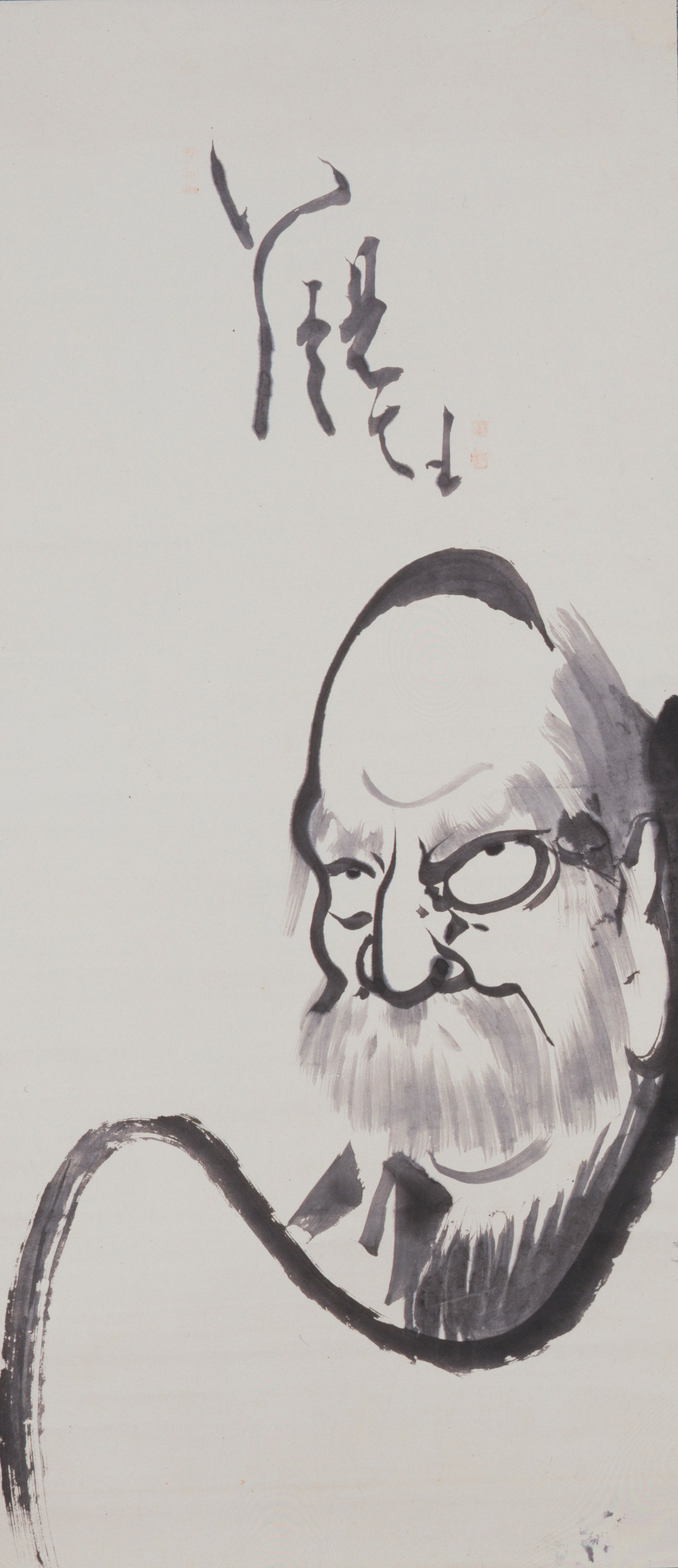
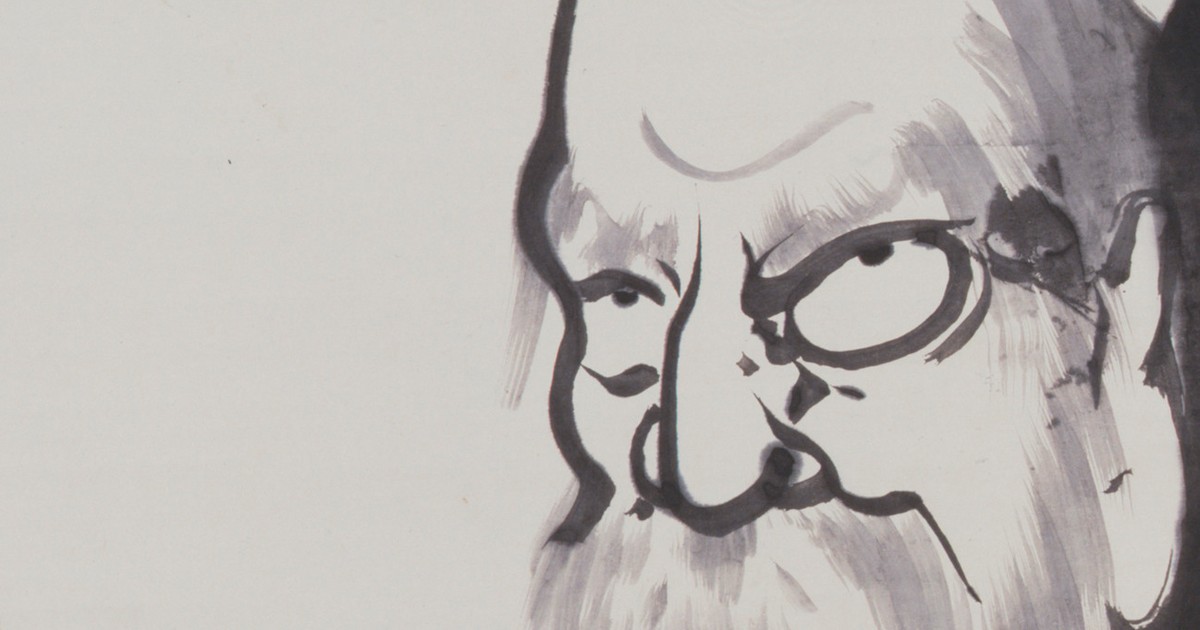
The Tokyo National Museum's Bodhidharma is a hanging scroll in ink on paper, 123.0 by 55.5 cm. Bodhidharma's face fills the right side of the tall sheet, his eyes wide open; his robe is a single thick stroke of ink sweeping in a broad curve, and an inscription is written in the upper part. Look at the width and speed of the brush and the depth of the ink.
Other Subjects Hakuin Painted
Hakuin painted far more than Bodhidharma. Here are seven more of his works from the Tokyo National Museum and the Kyushu National Museum, all with images published on ColBase.
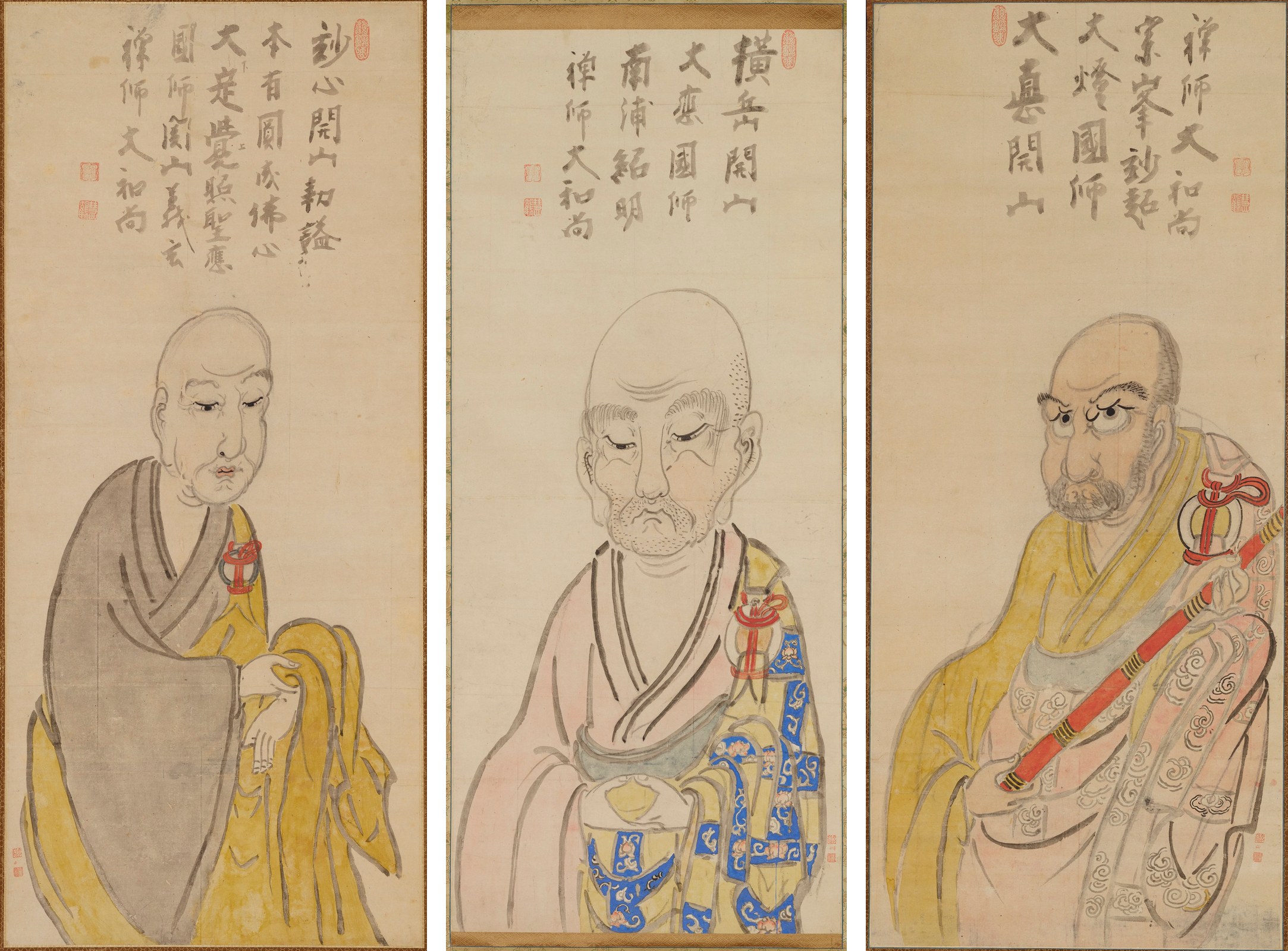
The Kyushu National Museum's Daiō, Daitō and Kanzan is a set of three hanging scrolls. According to the museum (in Japanese), Daiō Kokushi, who long served as abbot of Sōfuku-ji in Dazaifu, his Dharma heir Daitō Kokushi, and Daitō's own heir Kanzan Egen were three important Zen monks of the founding period of Rinzai Zen in Japan. Hakuin painted them as the most revered masters of the Rinzai lineage that led down to him. It is one of his few paintings in colour, and the museum notes that its soft brushwork and the easy way the underdrawing is left visible give it a charm of its own.
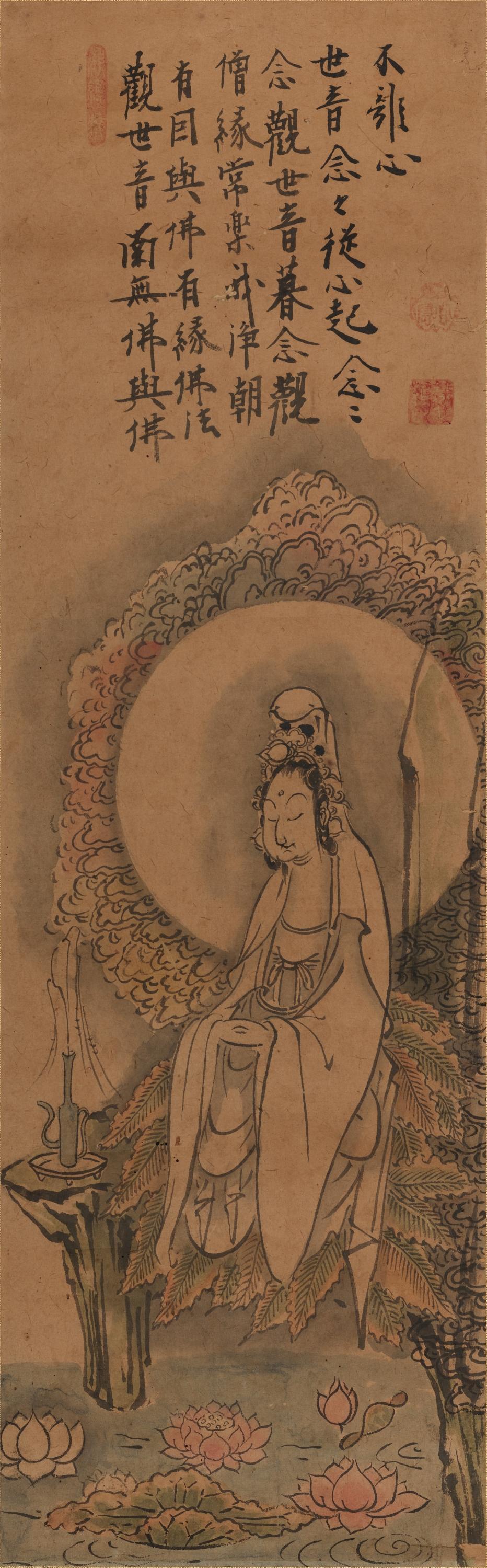
The Bodhisattva Kannon with a Willow Branch shows Kannon seated on a rock before a round halo, with a vase holding a branch to the left and lotus flowers in the water below; pale colour is added to the ink.
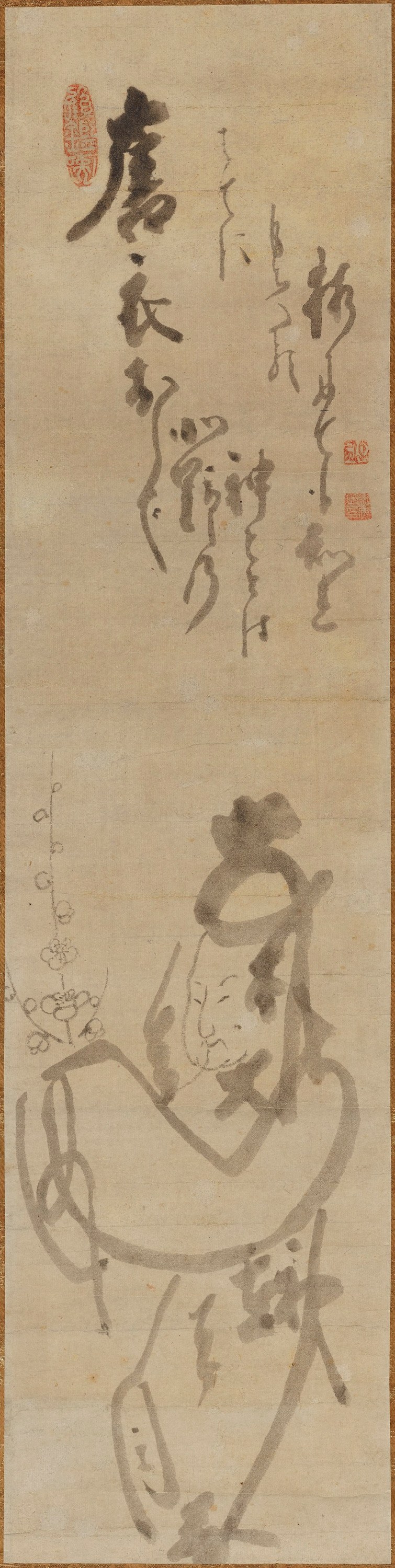
Tenjin Visiting Tang China shows a legend in which Tenjin, the deified scholar Sugawara no Michizane, crossed to China, studied Zen and received a monk's robe. According to the Kyushu National Museum (in Japanese), it is a moji-e, a picture drawn with written characters: only the face and the plum branch are drawn in fine lines, while the hat and robes are formed from the invocation Namu Tenman Daijizai Tenjin. The upper half carries a poem based on one attributed to Tenjin, ending with a single branch of plum. Hakuin made other pictures of this kind, and the museum regards this one as a typical example of his Tenjin in written characters.
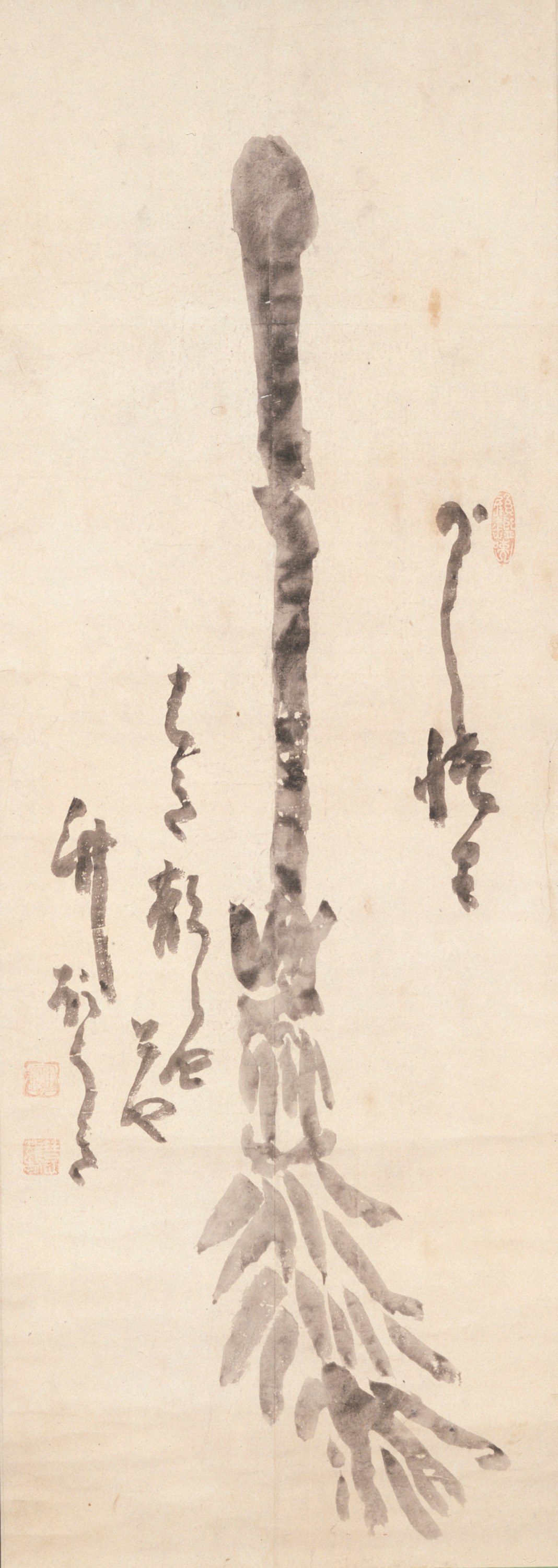
Broom shows nothing but a single broom on a tall sheet. The handle is in mottled ink and the bristles in short, broad strokes, with an inscription on either side of the handle.
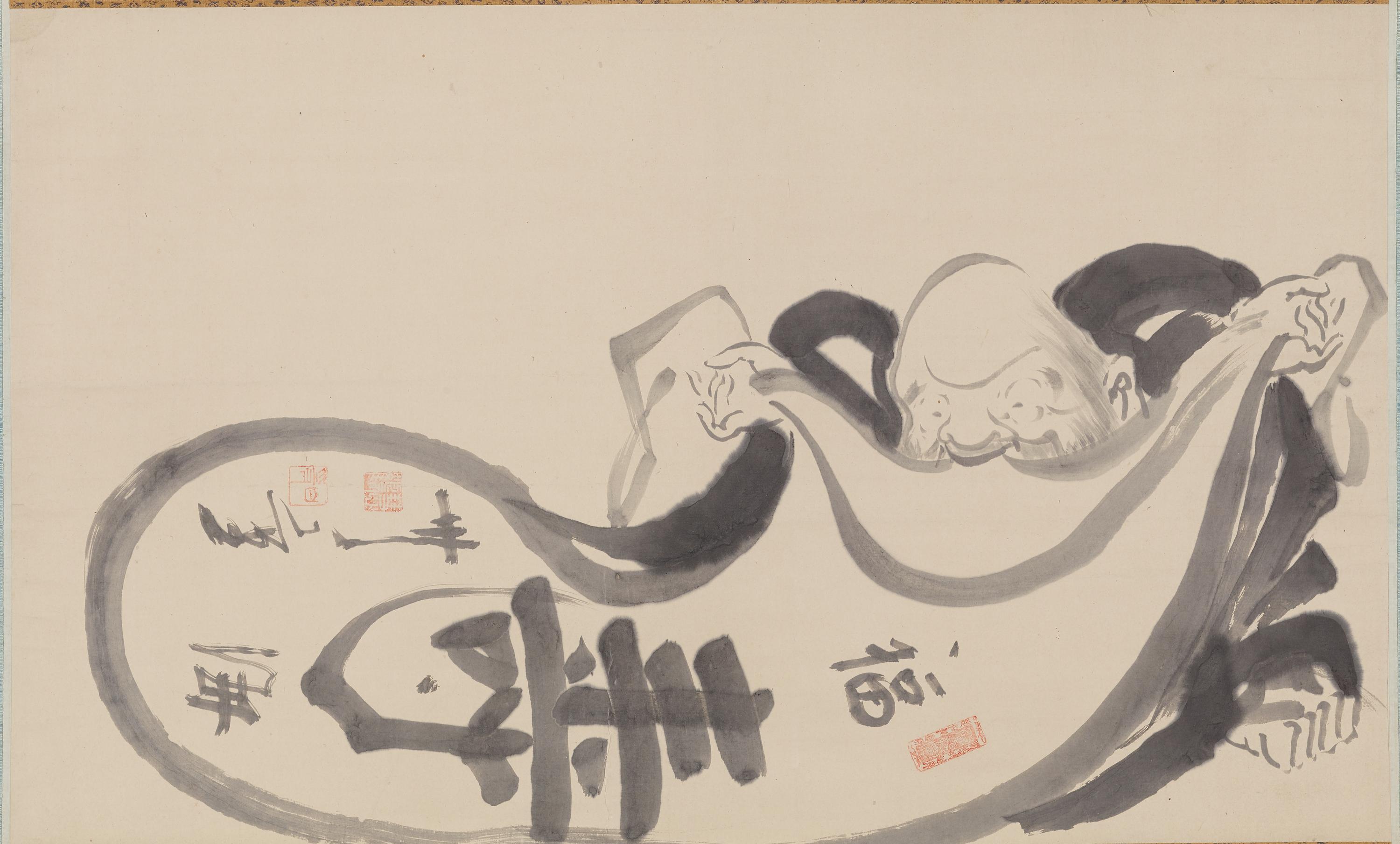
The Seven Lucky Gods were another of Hakuin's subjects. In The Monk Hotei, a smiling Hotei holds open the mouth of his huge bag with both hands; the bag sweeps to the left in a broad, pale curve, with large characters written inside it.
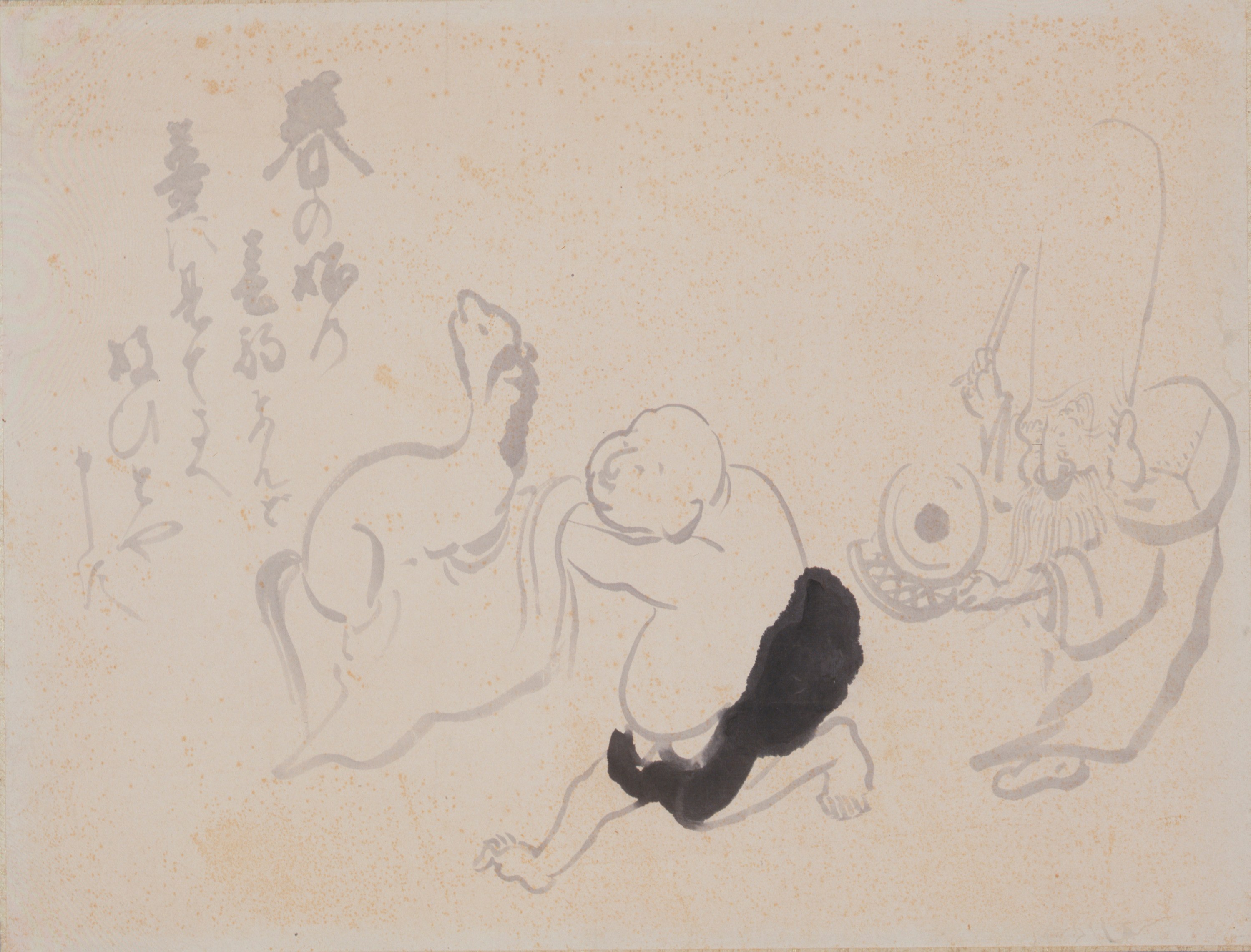
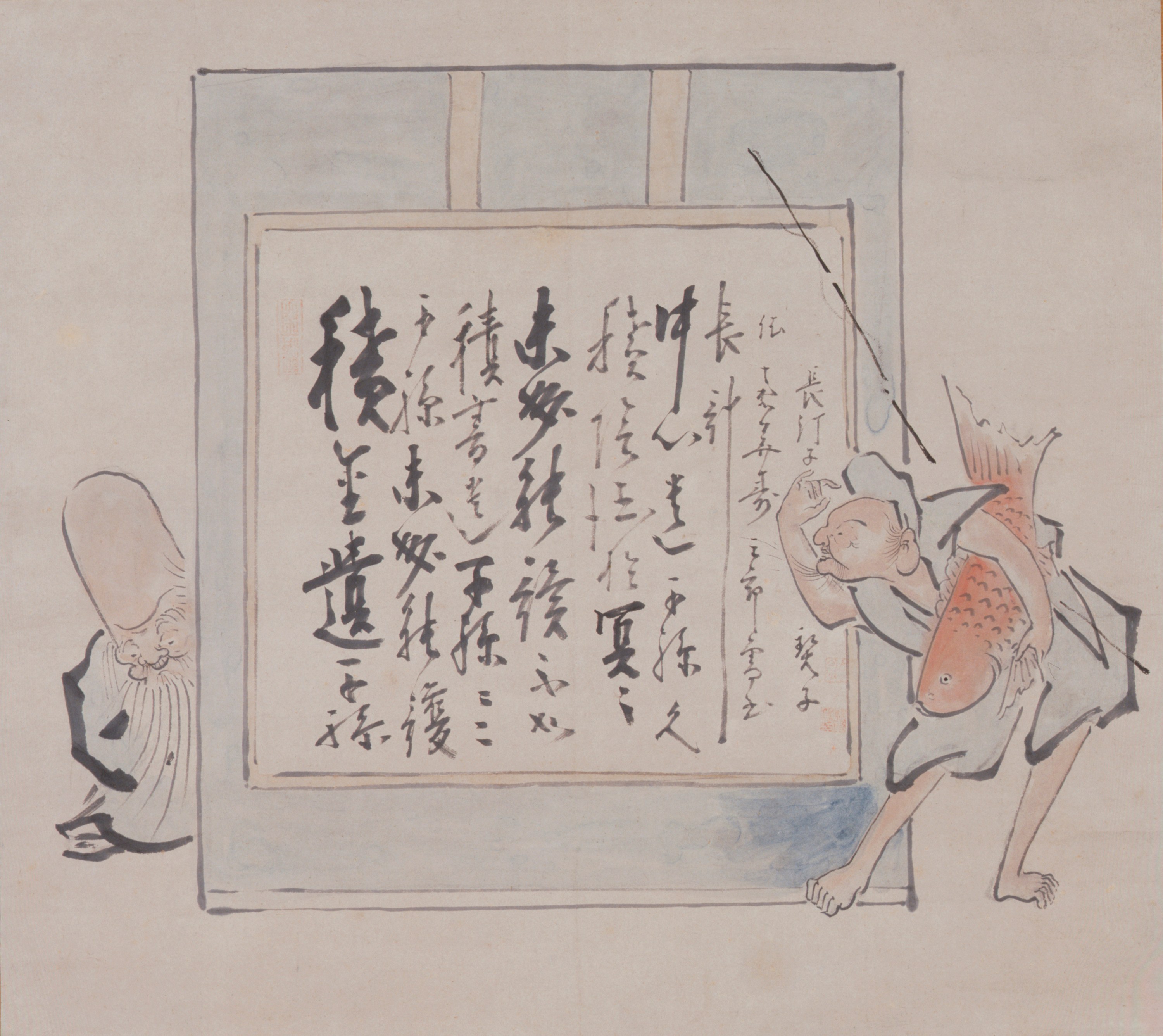
Harugoma, the spring horse of Hotei and the Spring Horse, is a New Year performance in which performers went from house to house singing and dancing with a horse's head made as a prop, held in the hand or ridden (Digital Daijisen dictionary, in Japanese). In the centre, Hotei in a black robe crouches with his hands on the ground, and a horse's head, raised upward, is drawn in pale lines to the left. In Family Precepts by the Gods of Good Fortune, a hanging scroll densely written with text fills the centre; on the right a figure carries a fishing rod and hugs a large red sea bream, and an old man with a tall head peeks in from the left edge.
Every one of these pictures combines painting with writing. You will meet Hotei again in the section on Bodhidharma and Hotei below.
Sengai Gibon | Laughter with a Sharp Edge
From Abbot of Shōfuku-ji to a Life of Poetry, Calligraphy and Painting
Sengai Gibon (1750–1837) was a Rinzai Zen monk born in Mino Province (present-day Gifu Prefecture), who entered Buddhist life at 11. From 1789 he served as abbot of Shōfuku-ji in Hakata, in present-day Fukuoka, which is regarded as Japan's first Zen temple. He retired in 1811 to the Kyohaku-in, a retreat within the temple, and gave his days to poetry, calligraphy and painting. He died in 1837 at 88.
His gift for painting showed itself from his fifties. A Japanese encyclopaedia says that his pictures, which ignore technique and follow their own way, represent the zenga of the Edo period together with Hakuin's. The Tokyo National Museum describes his work as humorous and light-hearted, and the Fukuoka Art Museum says that his approachable paintings and calligraphy made Zen easy to understand, so that people fondly called him Sengai-san of Hakata.
One of the largest collections of his work belongs to the Idemitsu Museum of Arts. The three works below are described following the museum's commentaries; images can be seen on the museum's Sengai page (in Japanese).
Hotei Pointing at the Moon
At first sight it is a gentle scene of Hotei playing with children. The inscription, though, a line about the moon (roughly, Honoured Moon, how old are you? Thirteen and seven), shows that the picture illustrates a basic Zen teaching known as Shigetsu Hotei, Hotei pointing at the moon.
According to the museum, the moon stands for the perfect state of awakening and the pointing finger for the sutras. Just as the moon hangs far beyond the finger, awakening in Zen, which does not rely on words and letters, cannot easily be reached by studying the sutras alone; it has to be won through hard practice. This was the first work to enter the Idemitsu collection.
Frog in Zazen
A single frog faces you with a grin; it spends its days in a posture that looks just like seated meditation. The inscription reads, roughly: If by sitting in zazen one could become a Buddha…
The museum reads it as a warning: if you cling to the form of seated meditation and lose sight of the spirit that seeks the Way, awakening will never come. It calls the picture a charming but stern warning to the disciples of the time, who tended to be caught up in form.
Circle, Triangle, Square: The Zen Painting with No Inscription
A simple sheet with only a circle, a triangle and a square. At the left edge there is just a signature saying that it was painted by Sengai of Shōfuku-ji, the first Zen temple in Japan; there is no inscription to give a clue to its meaning. The Idemitsu Museum says it is considered the most difficult of all Sengai's Zen paintings.
Some say it maps the stages of practice that lead to an awakening as complete as the full moon the circle stands for; others say it condenses the whole universe onto a small sheet by letting three shapes stand for everything that exists. Interpretations differ, and the fact that there is no single answer is part of its appeal.
How to Look at Zenga | Read the Inscription, Know the Figures, Watch the Brush
The Inscription Changes the Picture
Without its inscription, Frog in Zazen would simply be a picture of a grinning frog; read the words and a Zen teaching appears. Circle, Triangle, Square, which has no inscription, is read very differently by different viewers. In front of a zenga, look at the picture, read the inscription, then look at the picture again. If the cursive script is hard to read, a museum's commentary is the best way in.
Who Are Bodhidharma and Hotei?
Knowing the figures who appear again and again in zenga makes them much more enjoyable.
- Bodhidharma, known in Japan as Daruma, is regarded as the founder of Zen in China. He is said to have come from India and travelled to China in the early sixth century. According to legend he sat facing a wall for nine years at the Shaolin Temple on Mount Song until he reached awakening, and the round, limbless Daruma dolls that bob back up when knocked over take their shape from that seated figure
- Hotei (Budai in Chinese) is said to have been a Zen monk in China at the end of the Tang dynasty and in the Later Liang. He is described as wandering the streets with a big belly, a large bag and a staff, and was regarded as an incarnation of the bodhisattva Maitreya. In Japan he is one of the Seven Lucky Gods
Portraits of Zen patriarchs were one of Hakuin's main subjects, and Bodhidharma is regarded as the first of them.
Sengai's Waterfall: Three Strokes and a Rhythm of Ink
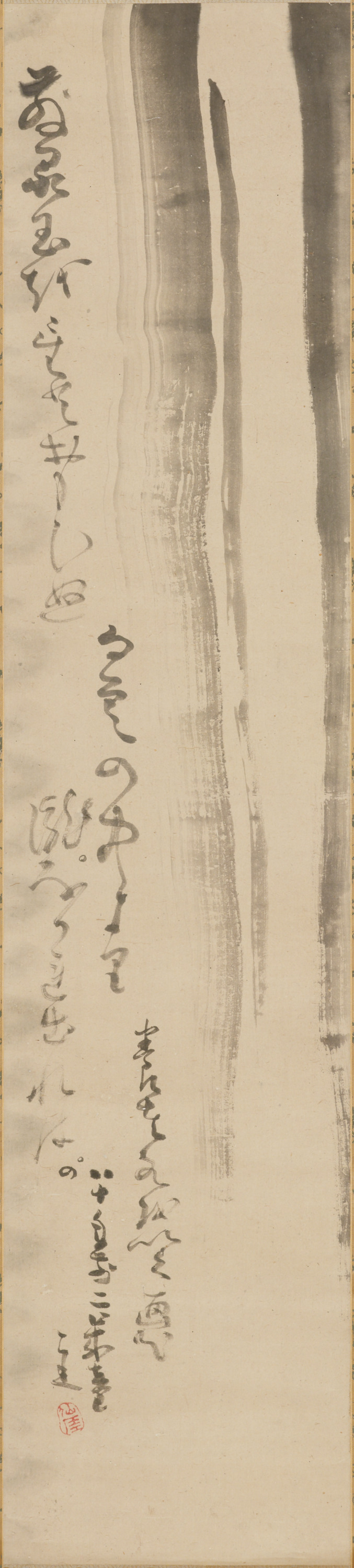
The Tokyo National Museum's Waterfall with a Waka Poem was painted in 1827, when Sengai was 78 by the traditional Japanese count; it measures 136.2 by 30.2 cm. On a narrow sheet he painted a waterfall and added a poem of his own as the inscription.
The poem likens the scattering drops to stars as the water pours out from among white clouds, and ends by noting that the picture was painted with the water of Yōrō, hinting that the falls are the Yōrō Falls in present-day Gifu Prefecture, whose water, legend says, turned into sake that brought long life.
What the museum's commentary points to is the line. The abundant flow is shown with just three strokes of ink full of water. Both the falls and the writing beside them start dark and grow paler and drier towards the bottom; then the brush is loaded again and the ink fades again. In that repeated rhythm, the commentary says, you can almost see the time it takes the water to fall from the top of the mountain.
Where to See Hakuin and Sengai
The Zen of Hakuin (Produced by Studio Ghibli), Kyoto
Planned and produced by Studio Ghibli and Nippon Television, this exhibition presents the messages in Hakuin's works through immersive projected images. Around 50 of his works are shown alongside the images, 31 of them from Shinshō-ji, a temple in Fukuyama, Hiroshima Prefecture (according to the organisers' announcements, in Japanese).
- Dates: December 17, 2026 – January 11, 2027
- Venue: Higashiyama Cube, Kyoto City KYOCERA Museum of Art
- Closed: Mondays (open on public holidays) and December 28 – January 2
- Hours: 10:00–18:00 (last admission 17:30)
It is the second half of Zen and Ghibli, which runs at the same venue until December 6. See the museum's exhibition page for tickets and details.
Museums That Hold Their Work
- Hakuin: the Eisei Bunko Museum in Tokyo (more than 300 works), the Tokyo National Museum (Bodhidharma, The Monk Hotei and others) and the Kyushu National Museum (Tenjin Visiting Tang China and others)
- Sengai: the Idemitsu Museum of Arts (Hotei Pointing at the Moon, Frog in Zazen, Circle, Triangle, Square and others), the Fukuoka Art Museum, and the Tokyo National Museum (Waterfall with a Waka Poem and others)
The works in the Tokyo and Kyushu national museums can be viewed on ColBase, the online collections database of Japan's national museums. Exhibition schedules, closing days and opening hours change, so check each museum's website before you go.
Trying It in Ink | A Waterfall in Lines, or in White Paper
Seen from the brush, zenga offer a few lessons. Sengai's waterfall takes just three strokes; Hakuin's Bodhidharma wears a robe of a single broad line. Ink loaded once into the brush, changing from dark to pale to dry as it runs, gives a picture rhythm on its own.
There is more than one way to paint the same subject in one colour of ink. Sengai painted the water of his falls itself, in three strokes.
In the video below, Tohun Kobayashi of Kokusai Bokuyukai paints a waterfall on a shikishi in ink alone. Here the water is not painted at all: he sets the rocks on either side and leaves the paper white, and the tones of the rocks turn that untouched paper into falling water. Fine lines added from the lip downwards give the speed of the flow, and he finishes with trees, a single small bird, his signature and a red seal.
It is a small landscape painted on a shikishi, not a recreation of zenga or of Sengai's method. Paint the water with lines, or leave it as white paper: treat them as two ways of thinking about the same waterfall.
To practise the change from dark to pale to dry, see How to Practise Sumi-e Brushwork; for landscapes that keep the white of the paper, see How to Paint a Sumi-e Landscape; and for painting a circle in one stroke, see the Ensō. Grind an ink stick on an inkstone, so that you can adjust the depth of the ink as you paint.
Frequently Asked Questions
What is zenga?
Zenga are paintings that try to express what has no form, such as Zen teaching and the state of awakening, in ink and words, according to Japanese dictionaries and encyclopaedias. They tend to be metaphorical and symbolic, and the Edo-period monks Hakuin and Sengai are the best-known painters.
What is the difference between zenga and sumi-e?
Sumi-e and suibokuga are names based on the medium and technique of painting in ink; zenga is a name based on who painted the work and why, to convey Zen teaching. Most of Hakuin's and Sengai's zenga are ink on paper, so they are ink paintings as well.
Who were Hakuin and Sengai?
Hakuin (1685–1768) was a Zen monk based at Shōin-ji in Hara, Suruga, known as the reviver of Rinzai Zen. Sengai (1750–1837) was abbot of Shōfuku-ji in Hakata and was fondly called Sengai-san of Hakata. The Tokyo National Museum describes Hakuin's style as distinctive and approachable, and Sengai's paintings and calligraphy as humorous and light-hearted.
What does Sengai's Circle, Triangle, Square mean?
It has no inscription and is considered the most difficult of Sengai's Zen paintings. It has been read as a map of the stages of practice leading to awakening, and as the whole universe condensed into three shapes; there are several interpretations, according to the Idemitsu Museum of Arts.
What are the words written on Zen paintings?
They are inscriptions written to suit the theme of the picture, such as poems or short phrases. Sengai's Frog in Zazen, for example, bears the words If by sitting in zazen one could become a Buddha… Reading the inscription often reveals what the picture means.
Why is Bodhidharma painted so often in zenga?
Bodhidharma is regarded as the founder of Zen in China, and portraits of Zen patriarchs were one of Hakuin's main subjects. Legend says he sat facing a wall for nine years, and Daruma dolls take their shape from that seated figure.
Where can I see Hakuin's work?
Around 50 of his works will be shown in The Zen of Hakuin (Produced by Studio Ghibli) at the Kyoto City KYOCERA Museum of Art from December 17, 2026 to January 11, 2027. The Eisei Bunko Museum in Tokyo holds more than 300 of his works, and the Tokyo National Museum's Bodhidharma can be viewed on ColBase. Check each museum's website before you go.
Where can I see Sengai's work?
The Idemitsu Museum of Arts holds Hotei Pointing at the Moon, Frog in Zazen, Circle, Triangle, Square and other works, and the Fukuoka Art Museum also holds his work. The Tokyo National Museum's Waterfall with a Waka Poem can be viewed on ColBase. Check the museums' websites for display schedules.
In Closing
- Zenga are paintings that try to show Zen teaching and the state of awakening in ink and in words
- Hakuin, the reviver of Rinzai Zen, used painting and calligraphy as a means of teaching; Sengai, the much-loved abbot of Shōfuku-ji in Hakata, wrapped sharp teachings in pictures that make people laugh
- Read the inscription, know the figures, watch the brush: these three clues open up most zenga
- Around 50 of Hakuin's works are on show in Kyoto from December 17, 2026 to January 11, 2027
Among our articles on artists and their works, Hokusai's Daily Exorcisms follows the lions Hokusai painted almost every morning in his eighties, and Hasegawa Tōhaku's Pine Forest looks at the National Treasure screens of pines in mist, painted with nothing but shades of ink. If you would like to pick up a brush yourself, start with Sumi-e Painting for Beginners.
RelatedArticle
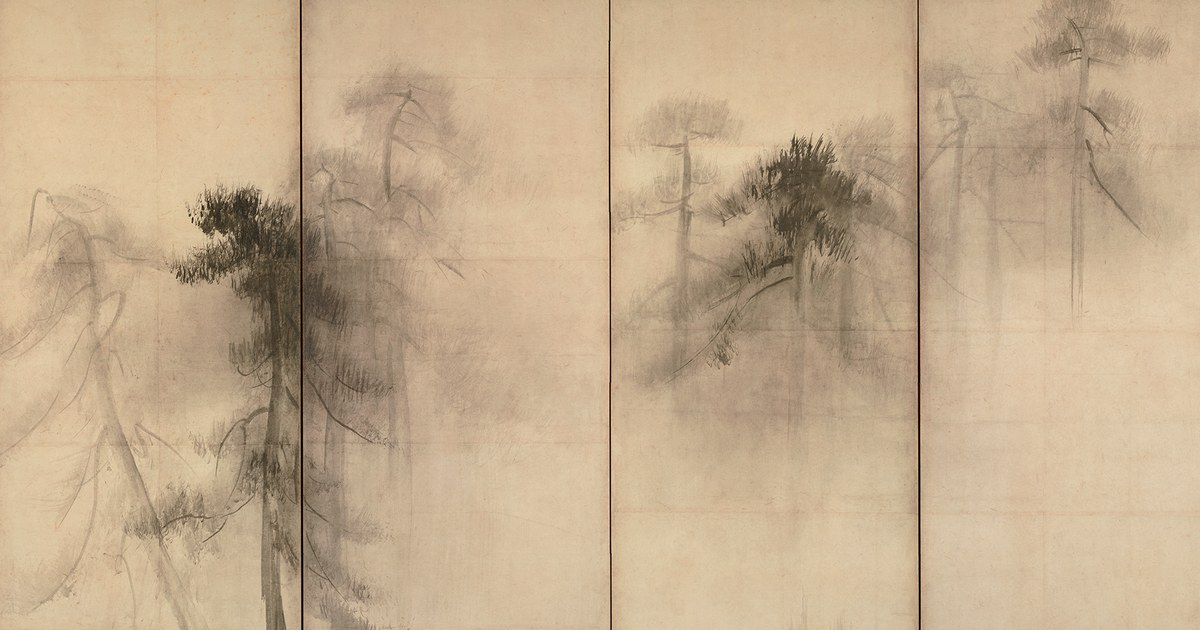
Hasegawa Tōhaku's Pine Forest: How to Look at Japan's National Treasure Screens of Mist and Ink
How to Paint Hydrangeas in Sumi-e: The Mokkotsu (Boneless) Technique in Three Steps
Kumano Brushes (Kumano Fude): Japan's Brush Town and Six Brushes Made There