From 1842, at 83 by the Japanese count, Hokusai painted a lion almost every morning to ward off evil. The Daily Exorcisms, three dated sheets, and their ink.
Hokusai's Daily Exorcisms (Nisshin joma-zu, 日新除魔図; titled Daily Sketches for Exorcism and Longevity by the Kyushu National Museum) are small ink paintings of lions that Katsushika Hokusai painted almost every morning from 1842, the year he turned 83 by the traditional Japanese count, into the following year. He painted them as a daily ritual, praying to drive away evil afresh each day. The Kyushu National Museum holds 219 sheets, which are designated an Important Cultural Property.
Hokusai is best known for woodblock prints such as Thirty-six Views of Mount Fuji, but in his later years he also made many paintings with his own brush. The Daily Exorcisms were not painted to order. Hokusai made them for himself, as a morning ritual to ward off misfortune. This article looks at them from the point of view of ink painting.
What this article covers:
- What the Daily Exorcisms show, and why they were painted
- How the 219 sheets at the Kyushu National Museum came down to us
- What to look for in three dated sheets
- What ink painters can take from a record of painting day after day
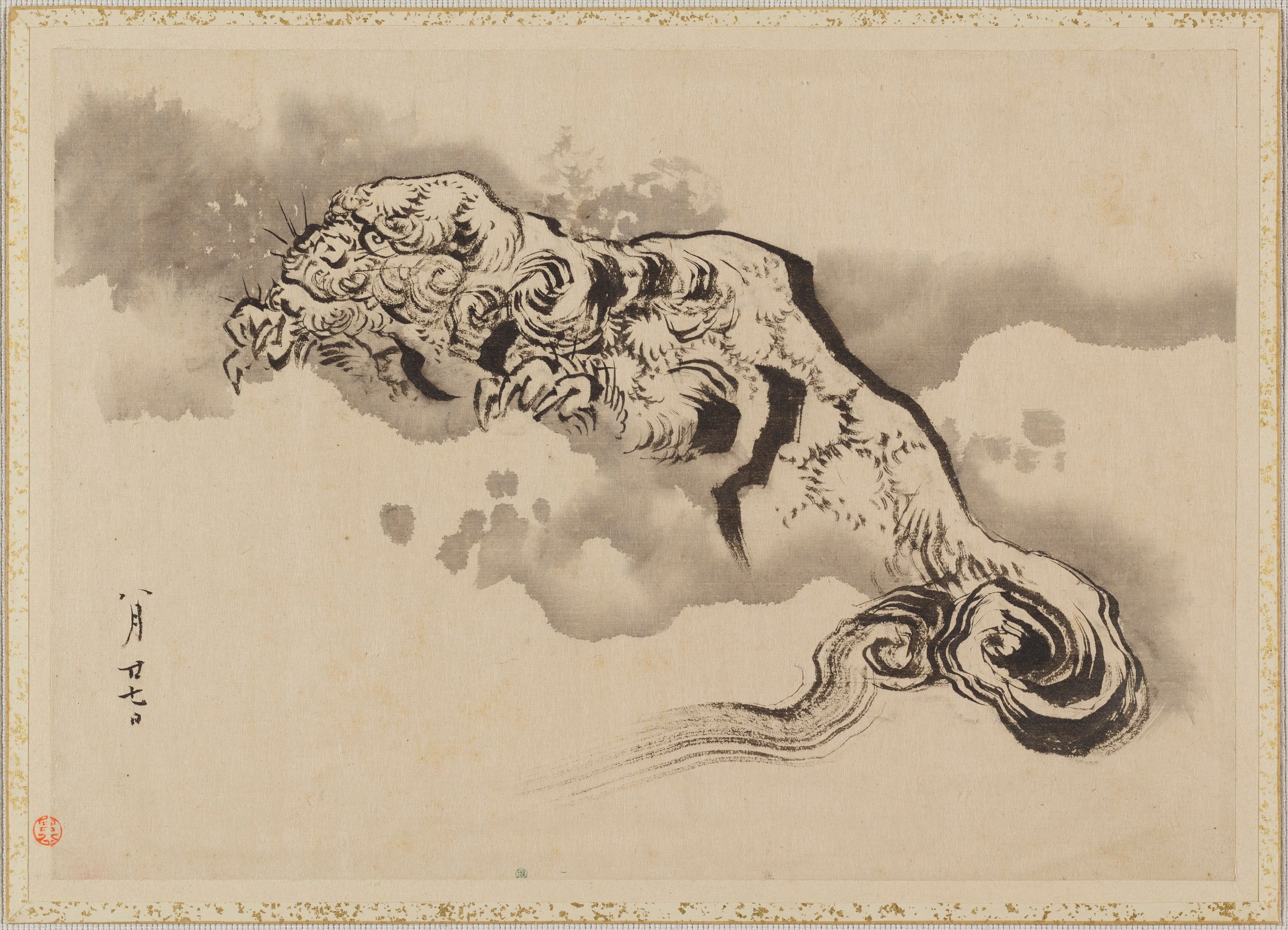
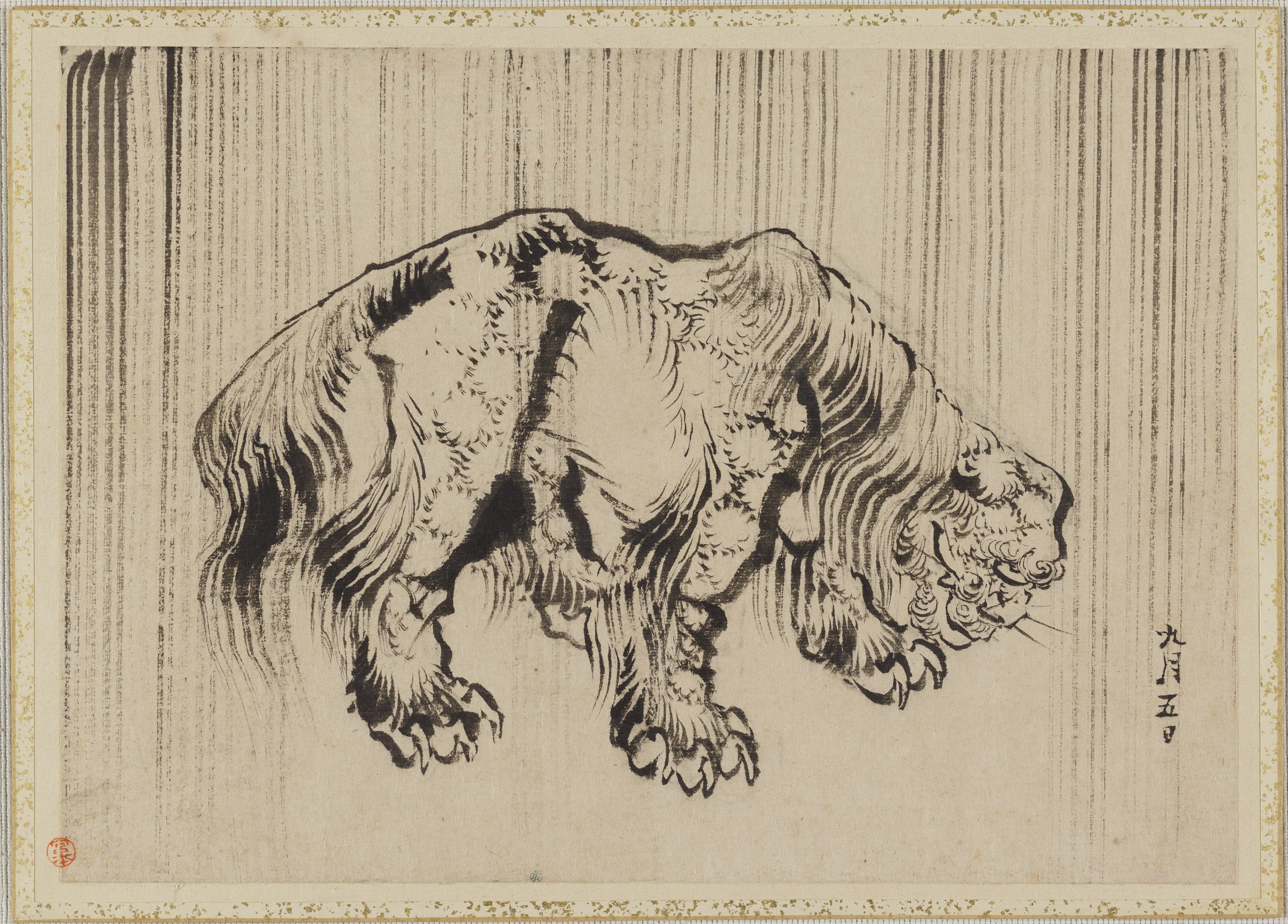
(Figure: Katsushika Hokusai, Daily Sketches for Exorcism and Longevity, sheet dated the 27th day of the eighth month, Edo period, 1842–43, ink on paper, Kyushu National Museum, Important Cultural Property / Source: ColBase. The image at the top of this article is another sheet from the same series, dated the 5th day of the ninth month.)
What Are Hokusai's Daily Exorcisms? | Lions Painted Almost Every Morning in His Eighties
The Daily Exorcisms are small pictures of lions (shishi), and of figures associated with lions. Each was painted on a small sheet of Japanese paper, and each carries the date on which it was painted.
Hokusai's work is usually discussed through his woodblock prints, but these are ink paintings made with his own brush, not prints. For the difference between prints and hand-painted works, see Reading Hokusai with an Ink Painter's Eye.
Key facts
| Item | Details |
|---|---|
| Title | Daily Sketches for Exorcism and Longevity (the Kyushu National Museum's English title); also known as the Daily Exorcisms (Nisshin joma-zu, 日新除魔図) |
| Artist | Katsushika Hokusai (1760–1849) |
| Date | Edo period, 1842–43 |
| Medium | Ink on paper |
| Number | 219 sheets |
| Dimensions | Each sheet 13.0–40.2 cm high and 13.5–40.3 cm wide |
| Collection | Kyushu National Museum (gift of Sakamoto Gorō) |
| Designation | Important Cultural Property |
These details follow ColBase and the Kyushu National Museum's collection gallery (in Japanese).
The Meaning of Nisshin Joma | Warding Off Evil, Day by Day
A private ritual, not a commission
According to the Kyushu National Museum, Hokusai prayed to drive away evil afresh each day, and almost every morning he painted lions, or figures associated with lions, as a daily practice. The title, nisshin joma, expresses that wish: each new day, ward off evil.
The museum explains that, unlike works made to order, these were painted by the artist himself to keep misfortune away, and that their very private character is what makes them so valuable. They were never meant for a client's eyes. What survives is Hokusai's daily routine, just as it was.
Dates in the old lunar calendar
Each picture records the day it was painted, in the old lunar calendar, written in forms such as 八月廿七日 (the 27th day of the eighth month) or 九月五日 (the 5th day of the ninth month). Seeing the dates, you can feel that every sheet was painted on one particular morning.
Hokusai lived to 90 by the traditional count, as ColBase notes in its description of another of his paintings. The Daily Exorcisms date from early in his eighties, late in that long life.
How the 219 Sheets Came Down to Us | The Miyamoto Family Set
Given at 88 to Miyamoto Shinsuke
Small lion paintings of this kind are scattered across collections in Japan and abroad. The largest group among them is the 219 sheets at the Kyushu National Museum.
These are known as the sheets that Hokusai, at 88 by the traditional count, gave to Miyamoto Shinsuke, a samurai of the Matsushiro domain in Shinano Province. Known as the Miyamoto family set, they were donated to the Kyushu National Museum in 2017, the gift of Sakamoto Gorō.
A wish-granting jewel and a recipe for long life
According to the Japanese description on ColBase, when Hokusai gave the set to Miyamoto he added a picture of a wish-granting jewel (hōju) and a recipe for a longevity medicine. The description presents them as glimpses of Hokusai's playful side.
A facsimile published in 1907
In 1907 a facsimile was published as Katsushika Hokusai Nisshin Jomachō (葛飾北斎日新除魔帖), edited by Murayama Jungo and published by Kokkasha. It can be viewed in the National Diet Library Digital Collections (in Japanese), where the dated lion pictures can be seen page by page.
Three Sheets Up Close | Clouds, Rain and an Abacus
ColBase publishes images of three of the 219 sheets. Let us look at them one at a time, together with their dates.
The 27th day of the eighth month | Running through bleeding clouds
A lion twists its body as it runs through clouds of pale ink that has bled into the paper. Its curls and the patches on its body are painted in dark ink, and the whorl of its tail with a thick brush. The date 八月廿七日 can be seen towards the left of the picture (the figure near the top of this article).
The 5th day of the ninth month | Walking through vertical lines
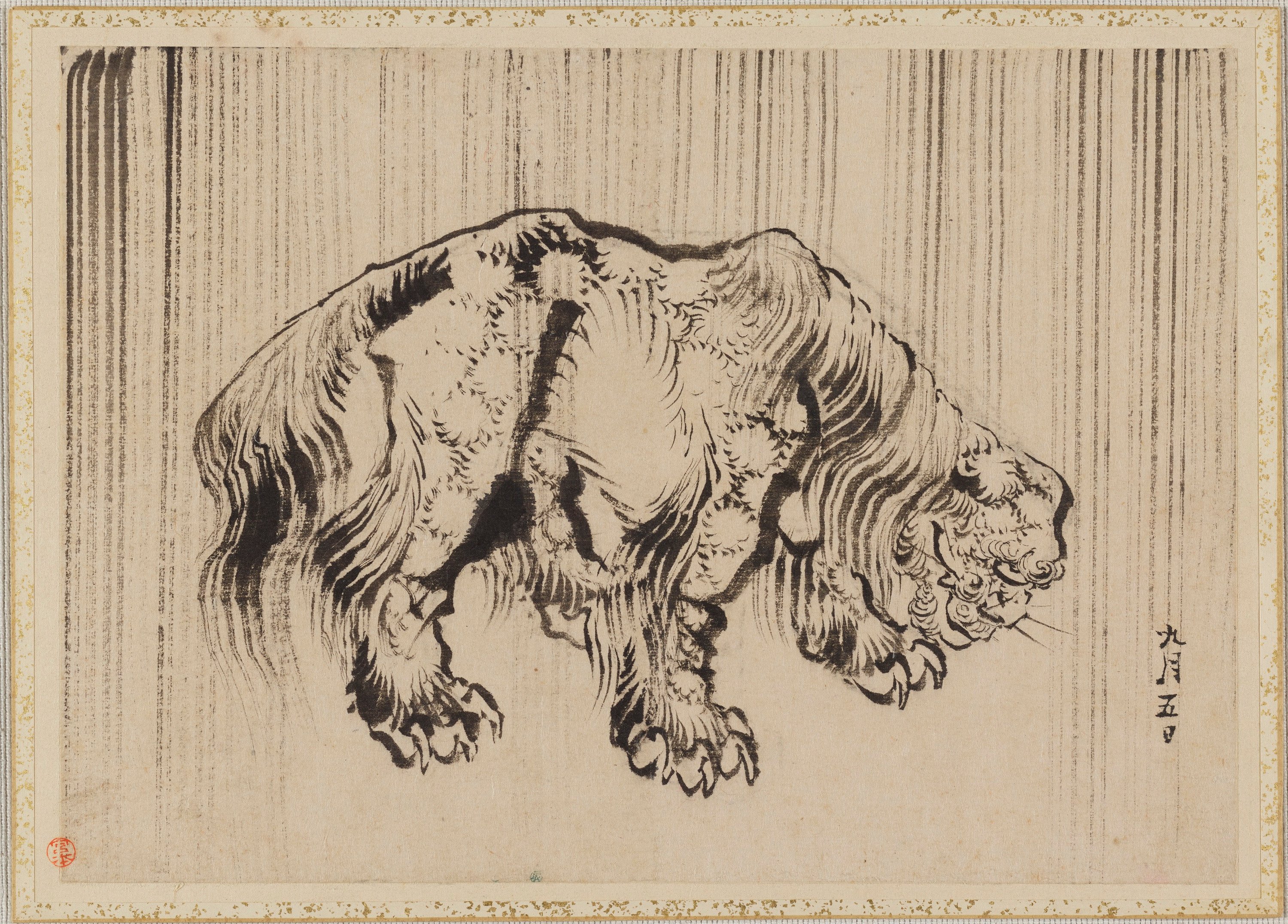
(Figure: Katsushika Hokusai, Daily Sketches for Exorcism and Longevity, sheet dated the 5th day of the ninth month, Kyushu National Museum / Source: ColBase)
The whole picture is filled with fine vertical lines, and through them a lion walks with its head lowered. The lines look like falling rain. Its fur is painted in dark ink with fine strokes.
The 12th day of the twelfth month | Crouching before an abacus
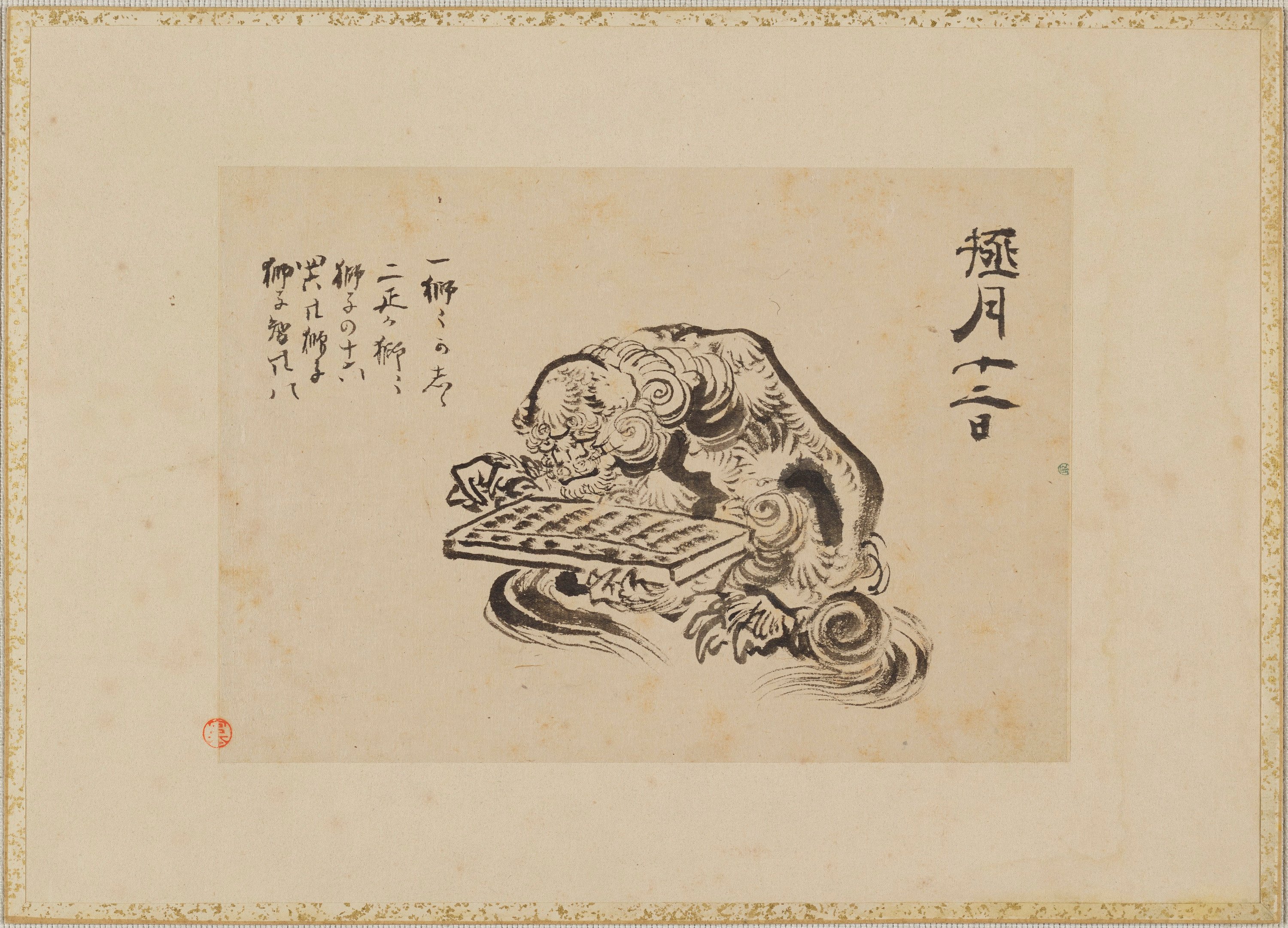
(Figure: Katsushika Hokusai, Daily Sketches for Exorcism and Longevity, sheet dated the 12th day of the twelfth month, Kyushu National Museum / Source: ColBase)
Here a lion crouches in front of an abacus. Gokugetsu (極月) is an old name for the twelfth month. There is an inscription at the upper left.
Hokusai painted not only bold lions racing through clouds but also a lion bent over an abacus. As the Kyushu National Museum puts it, the subjects were lions and figures associated with lions, and in his morning practice Hokusai painted them in many different guises.
Looking as an Ink Painter | Bleeding Clouds and Dark Fur
From here, we look at the ink in these sheets from a painter's point of view. What follows is what can be seen in the pictures, not a record of Hokusai's intentions.
Pale bleeding ink against dark ink
In the eighth-month sheet, the clouds are pale ink that has spread into the paper, leaving shapes without clear edges. The lion's curls and patches, by contrast, are set down crisply in dark ink. With ink that spreads pale and ink that stops dark on the same sheet, the lion's body seems to rise out of the clouds.
Lines of the same character, repeated
In the ninth-month sheet, the vertical lines run from top to bottom again and again, with a similar thickness and rhythm. Lining up strokes of the same character is a basic movement in sumi-e brushwork practice too. For exercises in line, see our sumi-e brushwork practice drills.
Another Lion | A Gold Folding Screen at the Tokyo National Museum
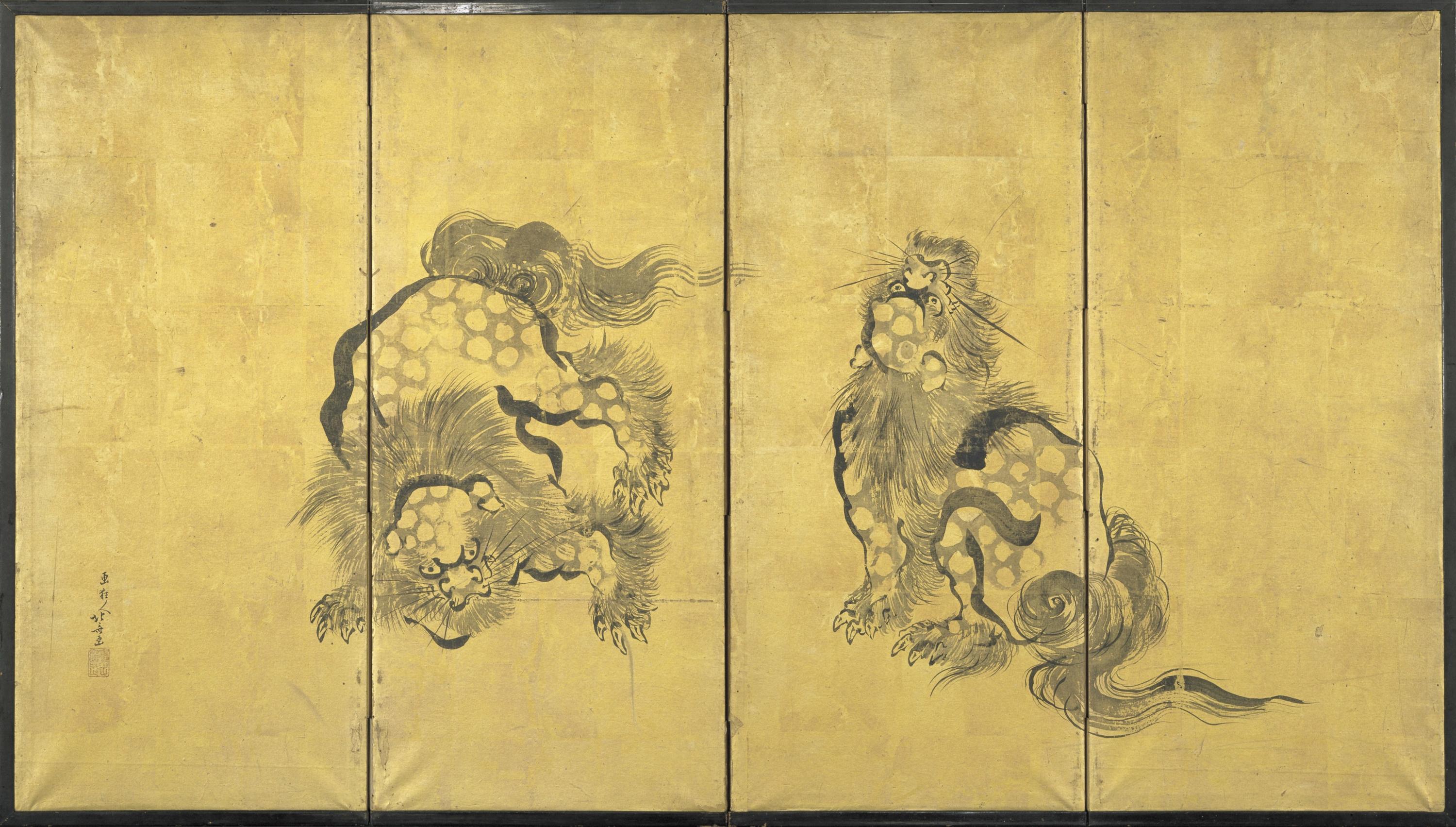
(Figure: Katsushika Hokusai, Lions, Edo period, 19th century, four-panel folding screen, ink and gold leaf on paper, Tokyo National Museum / Source: ColBase)
Apart from the small daily sheets, Hokusai also painted lions in ink on a gold ground: Lions, a single four-panel folding screen in ink and gold leaf on paper, 54.2 × 97.3 cm, at the Tokyo National Museum. Two lions are painted in ink on the gold. The one on the left twists its body and looks down, while the one on the right sits and looks up.
Set beside the small daily lions, the screen shows how much the impression of an ink lion changes with the size of the picture and the colour of the ground.
Painting Every Day | For Sumi-e Learners
The Daily Exorcisms were not painted as practice to improve. As the Kyushu National Museum explains, they were a daily ritual to keep misfortune away.
Even so, the record of Hokusai in his eighties taking up the brush almost every morning, and dating each sheet as he went, is an encouragement to anyone learning ink painting. On days when there is little time, paint one picture on a small sheet and write the date on it. Building up time with brush and ink, little by little, helps you develop a feel for line and tone.
For basic exercises in line and tone that fit easily into a daily routine, see our brushwork practice drills.
In Closing | Key Points, and Where to See Them
Key points
- The Daily Exorcisms are lion paintings that Hokusai painted almost every morning from 1842, the year he turned 83 by the Japanese count, into the following year, praying to drive away evil afresh each day.
- They were not a commission but Hokusai's own daily ritual against misfortune, and each sheet carries a date in the old lunar calendar.
- The 219 sheets at the Kyushu National Museum, known as the Miyamoto family set, are the largest group, and they are an Important Cultural Property.
- Small as they are, the sheets are full of ink, with pale bleeding washes set against crisp dark strokes.
Seeing the originals and the images
The originals belong to the Kyushu National Museum. Displays change over time, so check the museum's information before you visit. Images of three sheets can be seen on ColBase, and the 1907 facsimile album in the National Diet Library Digital Collections. If the terms sumi-e, suibokuga and nihonga tend to blur together, our explainer on sumi-e vs suibokuga sorts them out.
For Hokusai's prints and his hand-painted works, see Reading Hokusai with an Ink Painter's Eye. For ink painting by another Edo-period artist, see Itō Jakuchū's Vegetable Nirvana.
Frequently Asked Questions
What are Hokusai's Daily Exorcisms?
They are lion paintings that Hokusai painted almost every morning as a daily ritual, from 1842, the year he turned 83 by the traditional Japanese count, into the following year, praying to drive away evil afresh each day. The Kyushu National Museum holds 219 sheets, designated an Important Cultural Property, under the English title Daily Sketches for Exorcism and Longevity.
How is Nisshin joma-zu read, and what does it mean?
It is read nisshin joma-zu. The title expresses the wish to ward off evil afresh each day.
Why did Hokusai paint a lion every morning?
According to the Kyushu National Museum, it was a daily ritual to ward off evil, renewed each day. The paintings were not made to order but were private works painted for Hokusai himself.
How many sheets are there?
Small lion paintings of this kind are scattered across collections in Japan and abroad. The largest group is the 219 sheets at the Kyushu National Museum.
Where did the Kyushu National Museum's set come from?
It is known as the set that Hokusai, at 88 by the traditional count, gave to Miyamoto Shinsuke, a samurai of the Matsushiro domain in Shinano Province, and it is called the Miyamoto family set. It was donated to the Kyushu National Museum in 2017.
What are the dates written on the pictures?
They are the days on which the pictures were painted, written in the old lunar calendar: for example 八月廿七日 (the 27th day of the eighth month), 九月五日 (the 5th day of the ninth month) and 極月十二日 (the 12th day of the twelfth month). Gokugetsu is an old name for the twelfth month.
Where can I see the Daily Exorcisms?
The originals belong to the Kyushu National Museum. Displays change over time, so check the museum's information. Images of three sheets are on ColBase, and the facsimile album published in 1907 can be viewed in the National Diet Library Digital Collections.
What should ink painters look for in the Daily Exorcisms?
Look at the contrast between the clouds of pale bleeding ink and the lion's fur in dark ink, and at the brush repeating lines of the same character again and again. That they are a record of painting day after day, with each sheet dated, is also an encouragement to anyone who paints.
RelatedArticle
What Is Mōrōtai? Hishida Shunsō and the Hazy Style of Nihonga Without Outlines
What Is Mokkotsu? The Boneless Technique and How It Differs from Kōroku