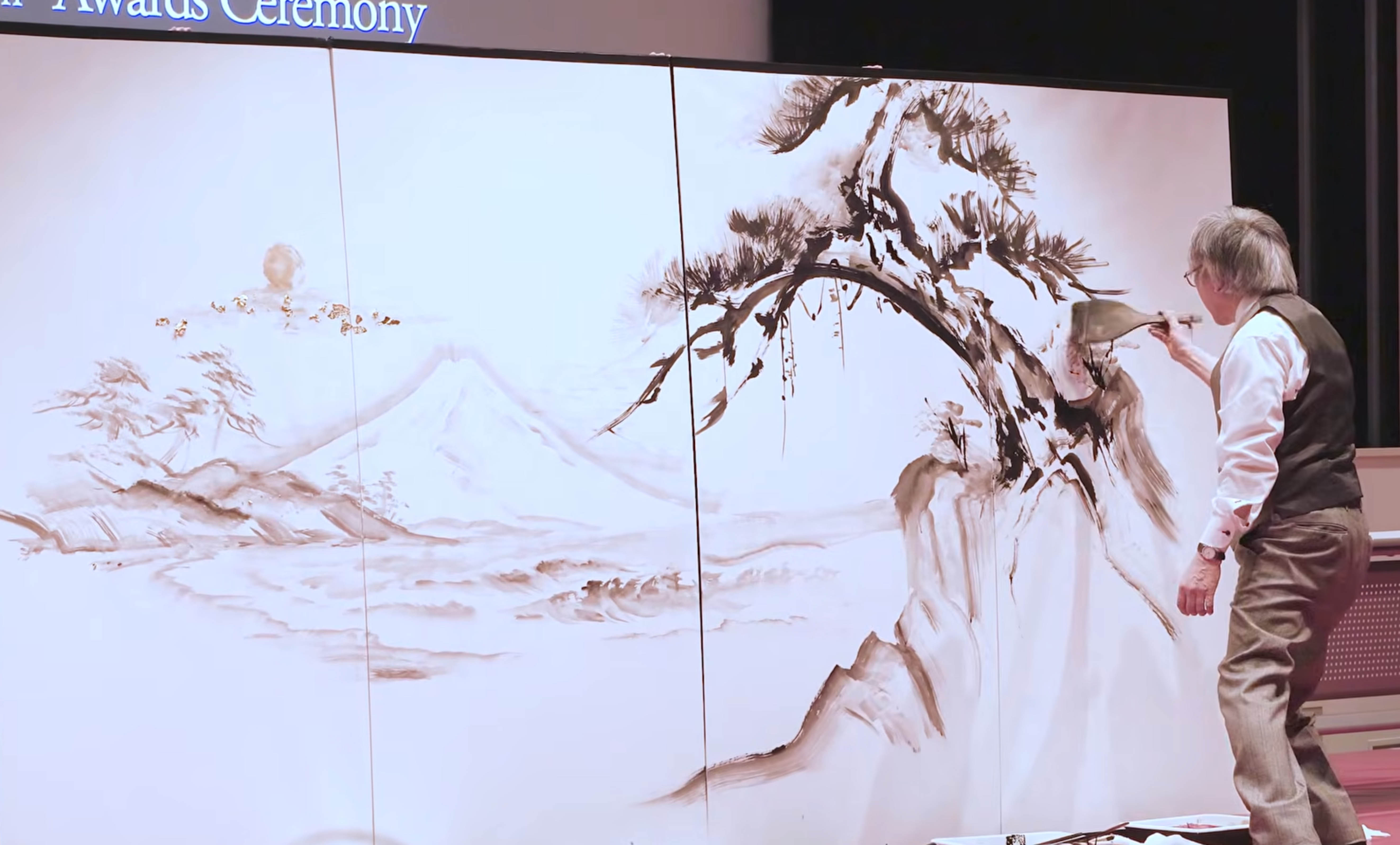
Chestnuts and the Chinese bellflower are autumn kigo in Japan. Two short sumi-e demonstrations, the seasonal words behind them, and two Edo paintings.
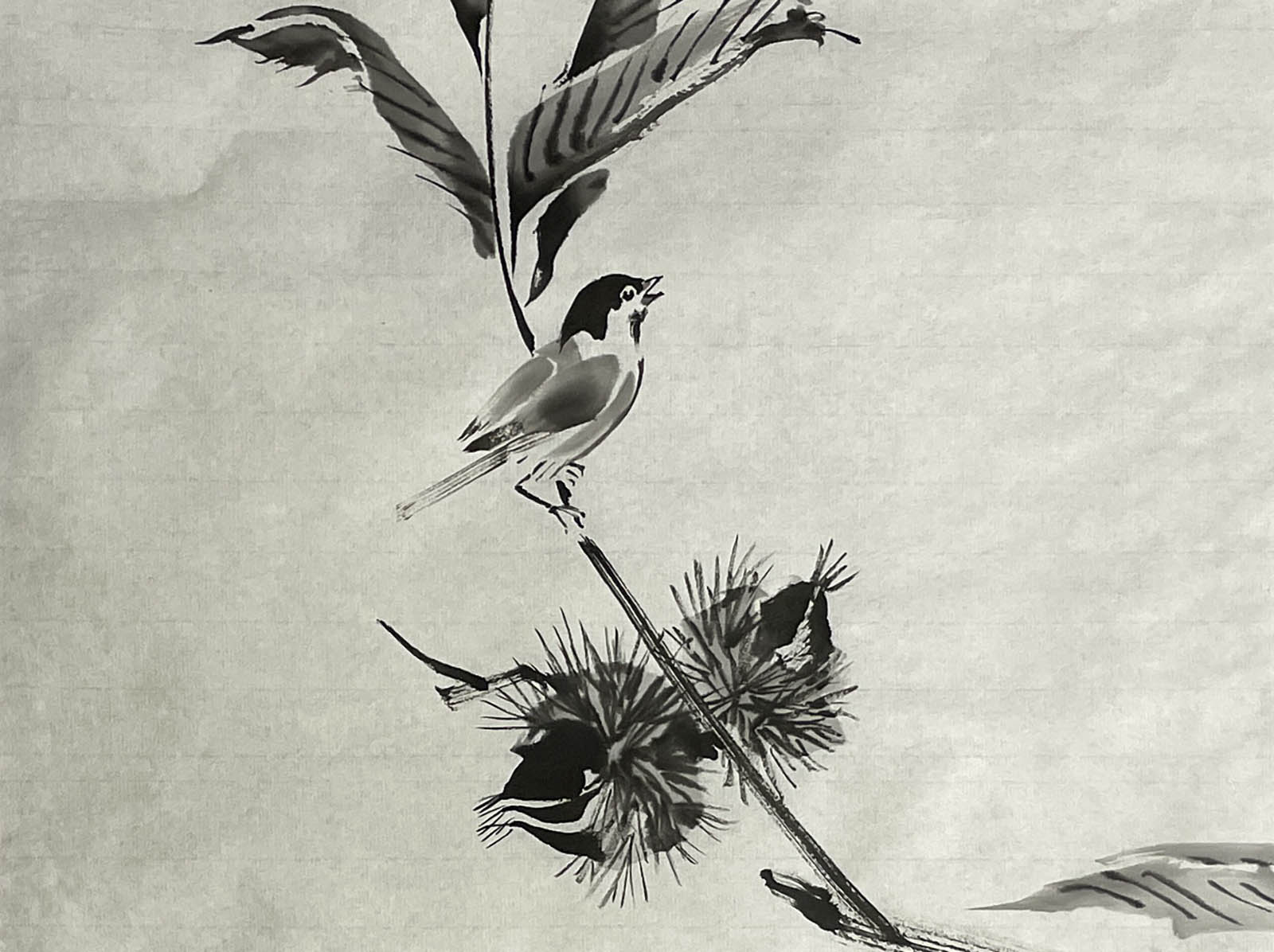
The chestnut and the Chinese bellflower (kikyō) are both kigo, the seasonal words of Japanese poetry, and both belong to autumn. Kikyō is also one of the seven flowers of autumn. If you are looking for autumn subjects in sumi-e, these two make the season unmistakable.
This article introduces the chestnut with a small bird, and the Chinese bellflower, as autumn subjects. It draws on two short demonstration videos published on the Kokusai Bokuyukai (International Association of SUMI) YouTube channel in September 2026, and on paintings by Edo-period artists.
In this article:
- Why the chestnut and the bellflower are autumn subjects (kigo and the seven flowers of autumn)
- What to watch in the two short demonstrations, from the notes in their video descriptions
- Matsumura Keibun's Bird on Chestnut Branch and Tawaraya Sōtatsu's Balloon Flowers and a Rabbit
- Other autumn subjects: autumn grasses, fruit and the chrysanthemum
Autumn Motifs in Sumi-e | Chestnuts and the Chinese Bellflower
Autumn subjects include things that ripen, such as the chestnut, and the grasses and flowers of the autumn fields, such as the bellflower.
Both show off the tones of the ink and the movement of the brush. With the chestnut, the contrast is between nuts laid down in pale ink and the spiky lines of the burr. With the bellflower, it is between petals flicked out one at a time and a stem drawn in a single breath. Each demonstration video packs its contrast into a very short time.
Chestnut and Small Bird | Spiny Burrs and Pale-then-Dark Ink
A seasonal word for autumn
As a kigo, the chestnut belongs to autumn, while chestnut blossom belongs to summer (Daijisen and Seisen-ban, "Kuri", in Japanese). Chestnuts still in their spiny husk are called igaguri, and this too is an autumn kigo (Kotobank, "Igaguri", in Japanese). The iga is the spiny outer case that encloses the nuts.
When the burr ripens it splits, and the nuts fall. In Japanese this is described as kuri ga emu, "the chestnut smiles" (Nihon Daihyakka Zensho, "Kuri", in Japanese).
Chestnuts have been written about for a very long time. In the Man'yōshū, the great eighth-century anthology of Japanese poetry, Yamanoue no Okura wrote a long poem about his children that includes the lines, loosely translated: "When I eat melons, my children come to mind; when I eat chestnuts, I long for them all the more" (Man'yō Hyakka, Book 5, poem 802, in Japanese). Further back still, large numbers of nuts, including chestnuts and walnuts, have been excavated at the Sannai-Maruyama site in Aomori (Agency for Cultural Affairs, in Japanese), and genetic and pollen analysis suggests that chestnuts were very probably cultivated there (Cultural Heritage Online, in Japanese).
What to watch in the demonstration
"Sumi-e Chestnut & Bird Painting Tutorial", on the Kokusai Bokuyukai channel, is a 29-second short in which a chestnut branch and a small bird are painted on washi in ink alone. In the channel's own words, it runs from the bird's first stroke through its body, the leaves, the chestnuts, their burrs and the reach of the branch, with no colour.
The description adds four working notes:
- The bird's head is placed with a single stroke, then the brush comes down to the breast to form the body.
- The serrated edges of the leaves come from the split tip of the brush, which is then laid down to make the surface of the leaf.
- The chestnuts are first laid down as a mass of pale ink, and dark ink is added before it dries.
- The spines of the burr are struck outward from the nuts in a radiating pattern, leaving drier brush tips towards the outer edge.
It is a short video, so it helps to watch for just two things: the moment dark ink goes into the pale nuts before they dry, and the dry brush tips left around the outside of the burr. To practise the difference between pale and dark ink, and the dry-brush effect, see five fundamental brushwork drills.
A classic example: Bird on Chestnut Branch
The pairing of chestnut and small bird also appears in Edo-period painting. One example is Bird on Chestnut Branch by Matsumura Keibun (1779–1843), in the Kyoto National Museum. Keibun excelled at bird-and-flower painting and contributed to the development of the Shijō school (Kotobank, "Matsumura Keibun", in Japanese).
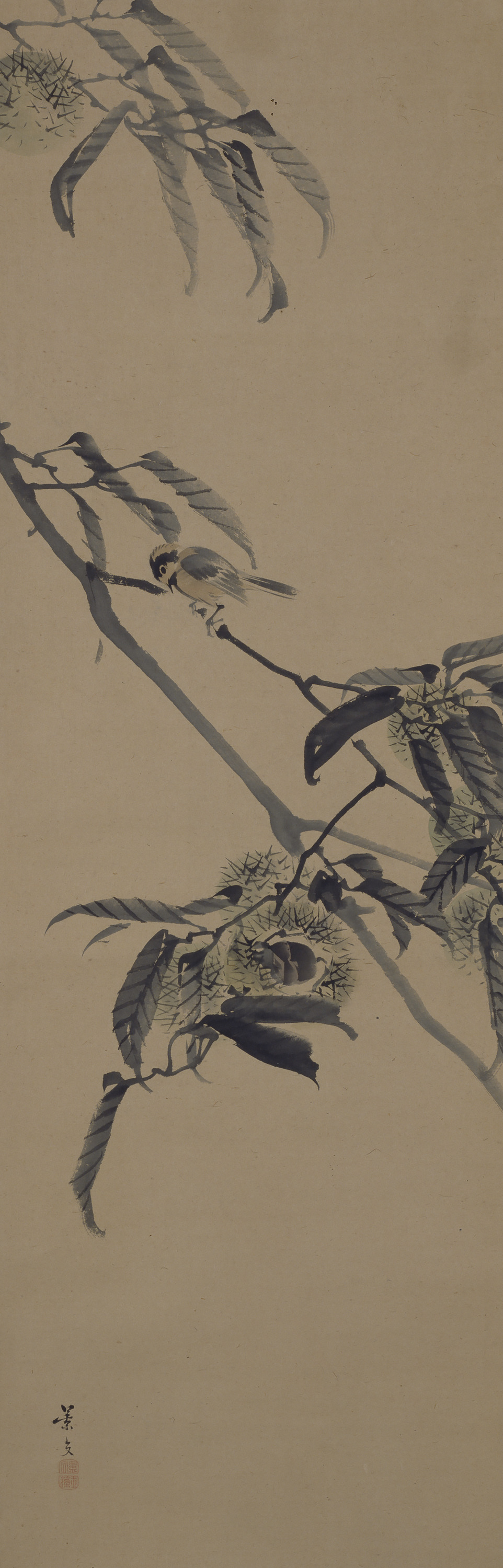
(Figure: Matsumura Keibun, Bird on Chestnut Branch, Edo period, 19th century, ink and light colour on paper, Kyoto National Museum / Source: ColBase)
A small bird perches on a branch that runs diagonally across the picture, with nuts in their spiny burrs and long, narrow leaves. In the middle of the picture a burr has split open to show the nuts: the smiling chestnut described above.
The painting is in ink with a light wash of colour on paper, so its technique differs from the ink-only demonstration. Even so, the spines drawn radiating around the nuts can be set against the demonstration's working notes.
Plants with birds: kachōga
A painting that sets birds among flowering plants is called kachōga, literally "bird-and-flower painting". The term also covers paintings of flowers alone, and of insects and animals (JAANUS). The Kyoto National Museum's collection database classifies Bird on Chestnut Branch as a flowers-and-birds painting (KNM Collection Database).
Chinese Bellflower | Five Petals and a Stem in One Breath
One of the seven flowers of autumn
The Chinese bellflower, kikyō, also known in English as the balloon flower, is an autumn kigo and one of the seven flowers of autumn, aki no nanakusa (Kotobank, "Kikyō", in Japanese). The seven are hagi (bush clover), obana or susuki (Japanese pampas grass), kuzu (kudzu), nadeshiko (fringed pink), ominaeshi (golden lace), fujibakama (thoroughwort) and kikyō (Kotobank, "Aki no nanakusa", in Japanese).
The seven go back to two poems by Yamanoue no Okura in Book 8 of the Man'yōshū (poem 1537 and poem 1538, in Japanese). In the first, the poet counts the flowers of the autumn fields on his fingers and arrives at seven kinds; in the second, he names them. Which flower the "asagao" of the second poem refers to is debated, but the most widely accepted view is that it is the kikyō (Seisen-ban and Nihon Daihyakka Zensho, "Aki no nanakusa", in Japanese).
What to watch in the demonstration
"Sumi-e Bellflower Painting Tutorial", also on the Kokusai Bokuyukai channel, is a 29-second short in which Chinese bellflowers are painted in ink on a shikishi, a square board for painting and calligraphy. In the channel's words, it runs from the first flower through the stems, the leaves and buds and the feathered plumes, to a final touch of gold.
The description gives three working notes:
- Each of the five petals is painted separately, flicked outward with the tip of the brush.
- The stem is drawn downward in one breath, tapering without the brush being reloaded.
- At the very end, a single dot of gold is added to the centre of a flower to finish it.
What to watch is how the brushwork changes between the petals and the stem: the petals flicked out one by one with the tip, the stem pulled down in a single breath without fresh ink. The gold is a single dot, at the heart of the flower.
A classic example: Balloon Flowers and a Rabbit
Bellflowers have also been painted in ink alone. Balloon Flowers and a Rabbit by Tawaraya Sōtatsu, in the Tokyo National Museum, is a 17th-century painting in ink on paper. Its description on ColBase says that a lone rabbit, faintly outlined in ink, looks up at the autumn moon. The moon itself is not painted, but the rabbit's upward gaze suggests it. Sōtatsu was fond of the theme and made several similar works (ColBase).
Wild kikyō is Near Threatened
Wild kikyō grows in the grassland of hills and fields from Hokkaidō to Kyūshū and the Amami Islands. On the Ministry of the Environment's Red List it is classed as Near Threatened (NT) in the fifth list, published in March 2025; in the fourth list (2020 edition) it was Vulnerable (VU). Pressure from over-collection in parts of its range is given as a reason for the assessment (Ministry of the Environment, Ikimono Log, in Japanese).
More Autumn Subjects | Autumn Grasses, Fruit and Chrysanthemum
Akikusa, "autumn grasses", is the collective name for grasses and plants that flower in autumn, such as kudzu, susuki, kikyō and ominaeshi (Kotobank, "Akikusa", in Japanese). The entry on bird-and-flower painting in Sekai Daihyakka Jiten explains that the main themes of Japanese bird-and-flower painting moved from pine, bamboo and plum towards cherry blossom and autumn grasses (Kotobank, "Kachōga", in Japanese).
Vegetables and fruit are subjects too. In Itō Jakuchū's Vegetable Nirvana, fruits and vegetables gather around a radish Buddha, and chestnuts are said to be among them; see Itō Jakuchū's Vegetable Nirvana.
The chrysanthemum, together with the plum, the orchid and bamboo, is one of the Four Gentlemen of ink painting; see the Four Gentlemen.
Frequently Asked Questions
What subjects are painted in autumn sumi-e?
Besides the chestnut with a small bird and the Chinese bellflower introduced here, autumn subjects include autumn grasses (akikusa), the chrysanthemum, one of the Four Gentlemen, and vegetables and fruit. These are only examples.
Which season does the chestnut belong to as a kigo?
The chestnut is an autumn kigo, while chestnut blossom belongs to summer. Chestnuts still in their spiny burr, called igaguri, are also an autumn kigo.
Is the Chinese bellflower one of the seven flowers of autumn?
Yes. The seven are hagi, obana (susuki), kuzu, nadeshiko, ominaeshi, fujibakama and kikyō. They go back to poems by Yamanoue no Okura in the Man'yōshū, and the most widely accepted view is that the "asagao" in his poem is the kikyō, although other views exist.
What is a painting of plants with birds called?
It is called kachōga, or bird-and-flower painting: an East Asian genre that sets birds among flowering plants. The Kyoto National Museum classifies Matsumura Keibun's Bird on Chestnut Branch as a flowers-and-birds painting.
In what order is the chestnut and bird painted in the demonstration?
According to the video description, it runs from the bird's first stroke through its body, the leaves, the chestnuts, their burrs and the branch. It is painted in ink alone, with no colour.
Why is gold added at the end of the bellflower demonstration?
The description says that, at the end, a single dot of gold is added to the centre of the flower to finish it. The gold is the final touch to a flower painted in ink, placed only at its centre.
Summary
- The chestnut and the Chinese bellflower are both autumn kigo, and the bellflower is one of the seven flowers of autumn.
- In the chestnut demonstration, watch dark ink go into the pale nuts before they dry, and the dry brush tips at the edge of the burr.
- In the bellflower demonstration, watch the five petals flicked out one by one and the stem pulled in one breath without fresh ink.
- In the Edo period, Matsumura Keibun painted Bird on Chestnut Branch (ink and light colour) and Tawaraya Sōtatsu painted Balloon Flowers and a Rabbit (ink on paper).
Choose one autumn subject, and start by watching the brush move in the video.
RelatedArticle
What Is Mokkotsu? The Boneless Technique and How It Differs from Kōroku
Art Beyond Boundaries 2025: A Live Sumi-e of Plum and Pine on a Gold Folding Screen