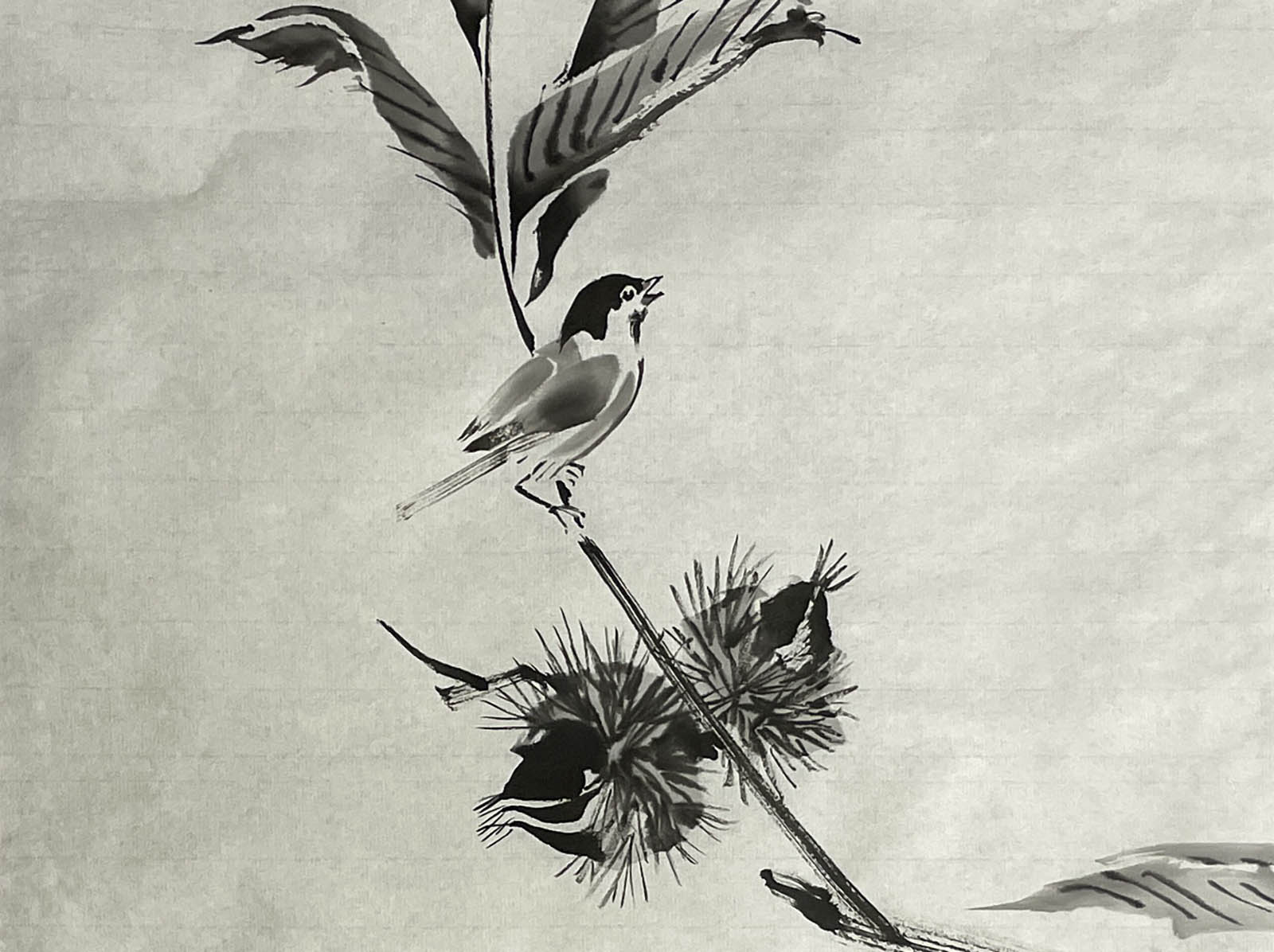
Mokkotsu, literally 'boneless', builds form without outlines. What it means, how it differs from kōroku, its history from China to Japan, and a demonstration.
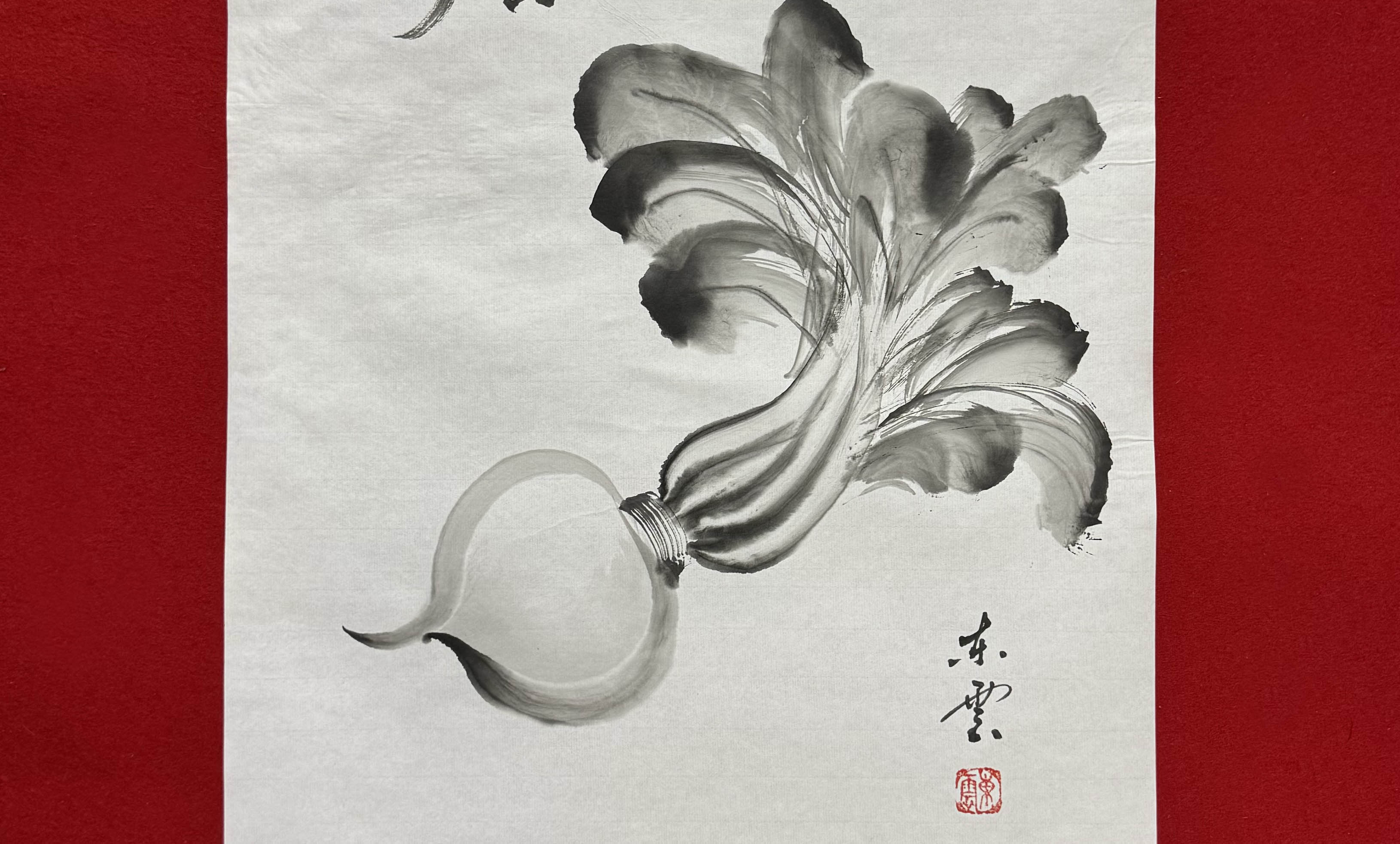
Mokkotsu (没骨, literally "boneless") is a technique of East Asian painting that builds form without outlines, spreading ink or colour as areas instead. Its counterpart is kōroku (鉤勒), which defines a form with a thin outline and then fills it with colour.
You will meet the word in sumi-e tutorials and museum labels, but it is not a technique of ink painting alone. Drawing on JAANUS, the dictionary of Japanese art terms hosted by Columbia University, and on Japanese dictionaries, this article explains what mokkotsu means, how it differs from kōroku, how it travelled from China to Japan, and how it is used in ink painting. If you are looking for a step-by-step exercise instead, our guide to painting a turnip in sumi-e walks through one.
In this article:
- What mokkotsu means, how it is pronounced, and what the "bone" refers to
- How it differs from kōroku
- Its path from Chinese bird-and-flower painting to Japanese ink painting and nihonga
- How mokkotsu is used in ink painting, with a demonstration video
What Is Mokkotsu? | Painting Without Outlines
In short
In mokkotsu you do not trace around a form with a line. You lay down ink or colour as an area, and the area itself becomes the form. JAANUS defines it as a painting technique in which objects are rendered without an outline, and counts it as one of the two primary painting techniques, the other being kōroku.
The Japanese encyclopedia Nihon Daihyakka Zensho (Nipponica) describes it in the same terms: a method of East Asian painting that forms shapes by spreading ink or colour as areas, without drawing outlines (Kotobank, in Japanese). The Seisen-ban Nihon Kokugo Daijiten dictionary adds that the method relies mainly on shading in ink or colour, that it is common in bird-and-flower painting, and that its character is light, pale and clear (Kotobank, in Japanese).
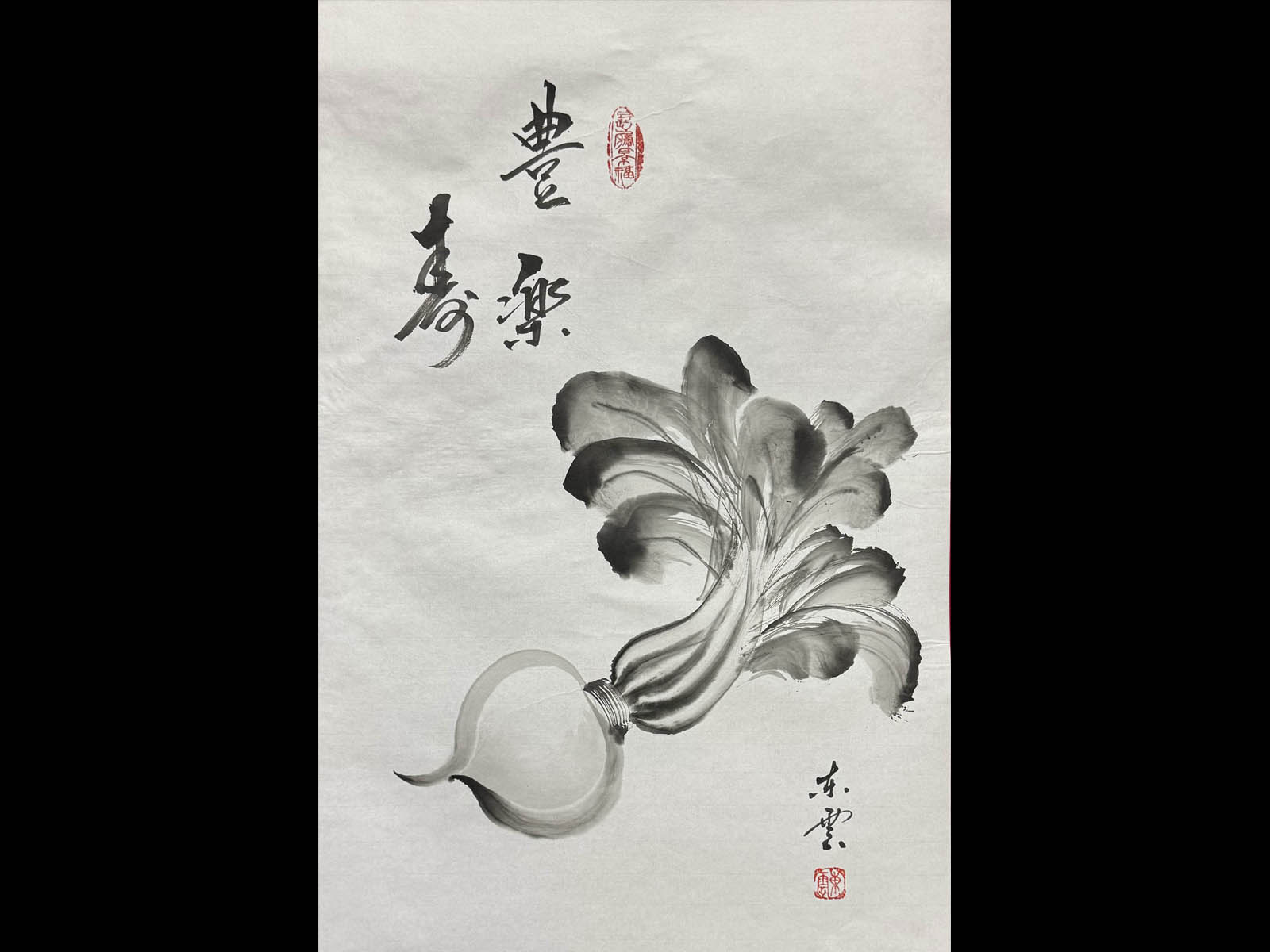
(Example: a turnip by Tohun Kobayashi, painted in the demonstration video introduced later in this article.)
Pronunciation and the meaning of "bone"
The usual reading is mokkotsu, and the technique is also called mokkotsu-hō, hō meaning "method". It is sometimes pronounced bokkotsu, and in Chinese it is mogu. Seisen-ban also records another name, bossen byōhō (没線描法), "the method of painting without lines".
The "bone" is the brush line that encloses the subject (Sekai Daihyakka Jiten, in Japanese). To paint without that line is to paint "boneless".
Mokkotsu vs Kōroku | Outline or Area?
What is kōroku?
Kōroku (鉤勒) defines an object with a thin outline and then adds colour. It is known in Chinese as goule and is also called sōroku (雙鉤). JAANUS describes it as the other primary technique alongside mokkotsu and notes that it is commonly used for paintings of flowers and grass. It was first used in China in the tenth century by Huang Quan (903–68), and it was in use in Japan by the fifteenth century. Painting colour inside such outlines is called kōroku tensai (鉤勒塡彩) (Sekai Daihyakka Jiten, "Kōroku", in Japanese).
The two techniques side by side
| Mokkotsu | Kōroku | |
|---|---|---|
| Outline | None | A brush line encloses the form |
| How the form is made | Ink or colour spread as areas | Outline first, colour inside (kōroku tensai) |
| Closest tradition | Ink painting, which captures its subject through gradations of tone | Line drawing (hakubyō) |
| Style in Chinese bird-and-flower painting | The Xu style | The Huang style |
Sekai Daihyakka Jiten explains that kōroku came before mokkotsu and is close to line drawing, while mokkotsu is close to ink painting, which captures its subject through gradations of tone.
A Short History | From Chinese Bird-and-Flower Painting to Japanese Ink and Nihonga
China: the Xu and Huang styles, and Yun Shouping
According to Nipponica, mokkotsu can be seen from the middle of the Tang dynasty and was established in the Song, when it was used for landscape, bird-and-flower and figure painting. JAANUS also dates its first appearance to mid-Tang painting. In bird-and-flower painting, the Xu style, the lineage of Xu Chongsi in the early Northern Song, is characterised by mokkotsu, while the Huang style, the lineage of Huang Quan, is characterised by kōroku.
Who started mokkotsu, however, depends on the dictionary. Some say that Xu Xi of the Five Dynasties began it and his grandson Xu Chongsi perfected it; some say that Xu Chongsi began it; others report works from an even earlier time. It cannot be traced to a single person.
In the Qing dynasty, Yun Shouping (1633–90), who used the art name Nantian, became known for flower paintings made from life in mokkotsu, and his bird-and-flower painting became the model of the period (Sekai Daihyakka Jiten, "Yun Shouping", in Japanese). JAANUS names Xu Chongsi and Yun Shouping as the artists most famously associated with the technique.
Japan: from Muromachi ink to modern nihonga
In the ink tradition, JAANUS notes, mokkotsu has been used to paint mountains since early times; it is thought to have entered Japan in the Muromachi period and is seen particularly in the work of Sōami (?–1525). In colour, it appears in bird-and-flower and fish paintings, primarily from the Edo period.
Nipponica goes further. In a broad sense, it counts the methods of the Rinpa painters Sōtatsu and Kōrin, and the tsuketate technique of the Maruyama-Shijō school, as kinds of mokkotsu.
In modern times, Yokoyama Taikan and Hishida Shunsō began, around 1900, to render atmosphere and space without line drawing. Critics in Japan, who prized line above all, mocked the result as mōrōtai, the "hazy style", although the same approach was well received at the exhibitions they held in the United States. A museum description on Cultural Heritage Online calls this a mokkotsu method (Cultural Heritage Online, in Japanese), while Seisen-ban describes mōrōtai as a method of painting without lines (bossen). The terms are not used consistently.
Mokkotsu in Ink Painting | Areas and Tones
Examples in ink
In ink painting, mokkotsu becomes a matter of building form from areas of the brush and tones of ink. Zōkei File, the art glossary of Musashino Art University, describes mokkotsu in ink painting as showing form with areas rather than outlines, using the character of the brush to express dark and light, wet and dry, slow and fast (in Japanese).
One example is a seventeenth-century Ming-dynasty hanging scroll of vegetables, painted in ink on silk, in the Tokyo National Museum (墨菜図軸). Its description says the leaves are painted in mokkotsu without outlines, and notes that vegetables were often painted as symbols of the life of scholar-officials and Zen monks (Cultural Heritage Online, in Japanese). Vegetables are also the subject of the demonstration later in this article.
Another is an ink painting on silk of a lotus pond and white herons (蓮池白鷺図), designated an Important Cultural Property. Its description says the brushwork is mainly mokkotsu and keeps the moist quality of ink, and dates the painting to the Yuan dynasty or not long after (Cultural Heritage Online, in Japanese).
JAANUS adds a note of caution: according to some specialists, mokkotsu should properly refer only to painting in colour, although the term is also commonly used for ink renderings without outlines.
Tsuketate and the tsuketate brush
A technique close to mokkotsu is tsuketate (付立). JAANUS calls it a type of mokkotsu: it uses no outline, and creates forms with a flourish of the brush that expresses volume and colour at the same time. Maruyama Ōkyo (1733–95) and the Maruyama-Shijō school are famous for it. Japanese dictionaries describe loading one brush with two tones of ink or pigment and painting in a single sweep, with the brush laid on its side so that dark and light appear within one stroke (Daijisen and Seisen-ban, in Japanese).
Whether tsuketate counts as mokkotsu depends on the source. JAANUS and Nipponica treat it as a kind of mokkotsu, while the entry on nihonga in Sekai Daihyakka Jiten lists the two as separate techniques.
The special brush for the technique, the tsuketate-fude (付立筆), has long, thick, flexible bristles (JAANUS). It is also known as a mokkotsu brush, mokkotsu-fude (Musashino Art University, Zōkei File, in Japanese).
See It Painted | Tohun Kobayashi's Turnip
What to watch
The video below shows Tohun Kobayashi painting a turnip in ink. It is published on the Kokusai Bokuyukai (International Association of SUMI) YouTube channel.
Look out for two things:
- The leaves are laid down as broad areas with the belly of the brush, leaving darker ink at their tips.
- The white root is suggested by a pale arc of ink on one side and the white of the paper.
Fine lines do appear for the leaf veins, the stems and the neck of the root. But the turnip is not enclosed by an outline. It is built from areas and tones, which is the idea at the heart of mokkotsu.
For the step-by-step method
If you want to try it yourself, our guide to painting a turnip in sumi-e walks through the steps, using ink tones and empty space. To practise ink tones on their own, see five fundamental brushwork drills.
Frequently Asked Questions
How do you pronounce mokkotsu?
It is read mokkotsu, and the technique is also called mokkotsu-hō. It is sometimes pronounced bokkotsu, and another name for it is bossen byōhō, "the method of painting without lines".
What is the difference between mokkotsu and kōroku?
Mokkotsu builds form without outlines, spreading ink or colour as areas. Kōroku defines form with a thin outline and then adds colour inside it. JAANUS counts them as the two primary painting techniques.
Who invented mokkotsu?
Dictionaries disagree. In bird-and-flower painting it is associated with Xu Chongsi of the Northern Song and the Xu style, but some accounts say Xu Xi of the Five Dynasties began it, and others report works from an earlier time. It cannot be traced to one person.
Is mokkotsu only used in ink painting?
No. It is a technique of East Asian painting used in both ink and colour. JAANUS notes that some specialists would limit the term to painting in colour, although it is also commonly used for ink renderings without outlines.
What is the difference between tsuketate and mokkotsu?
Tsuketate paints without outlines, using a brush loaded with dark and light ink or pigment in a single sweep. JAANUS and Nipponica treat it as a kind of mokkotsu, while some Japanese dictionaries list it as a separate technique.
How can a beginner try mokkotsu?
Start by making forms from areas of the brush and tones of ink, instead of enclosing them with lines. Our turnip guide walks through the steps alongside the demonstration video.
Summary
- Mokkotsu (没骨, literally "boneless") builds form without outlines, spreading ink or colour as areas.
- Its counterpart is kōroku, which encloses form with a thin line. In Chinese bird-and-flower painting, mokkotsu marks the Xu style and kōroku the Huang style.
- Who began mokkotsu is told differently by different dictionaries.
- In Japan it runs from Muromachi ink painting through the Edo schools, in a broad sense, to the mōrōtai of around 1900.
- In ink painting, mokkotsu means building form from areas of the brush and tones of ink.
For the terms sumi-e and suibokuga, see what distinguishes sumi-e from suibokuga.
RelatedArticle
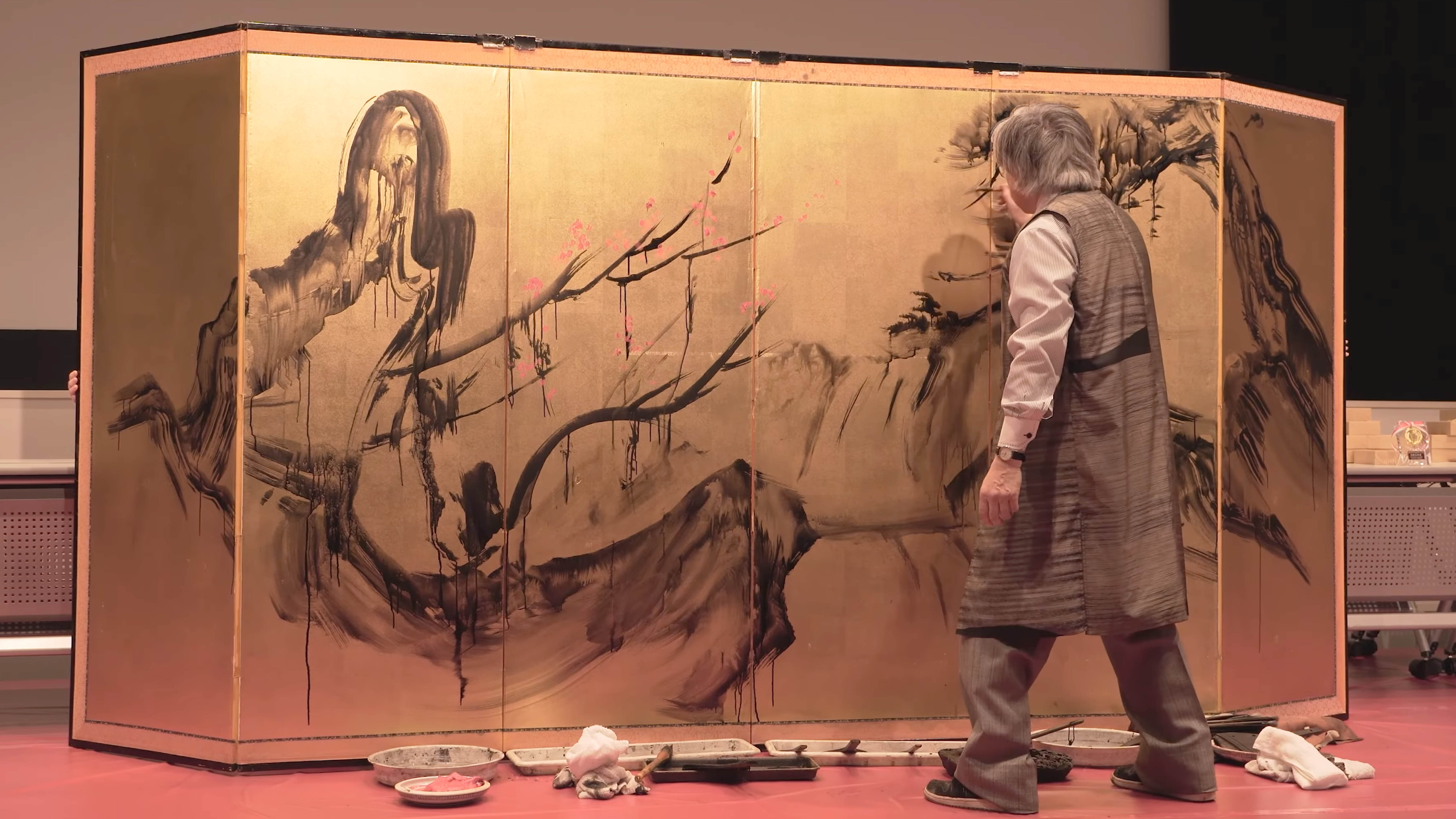
Art Beyond Boundaries 2025: A Live Sumi-e of Plum and Pine on a Gold Folding Screen
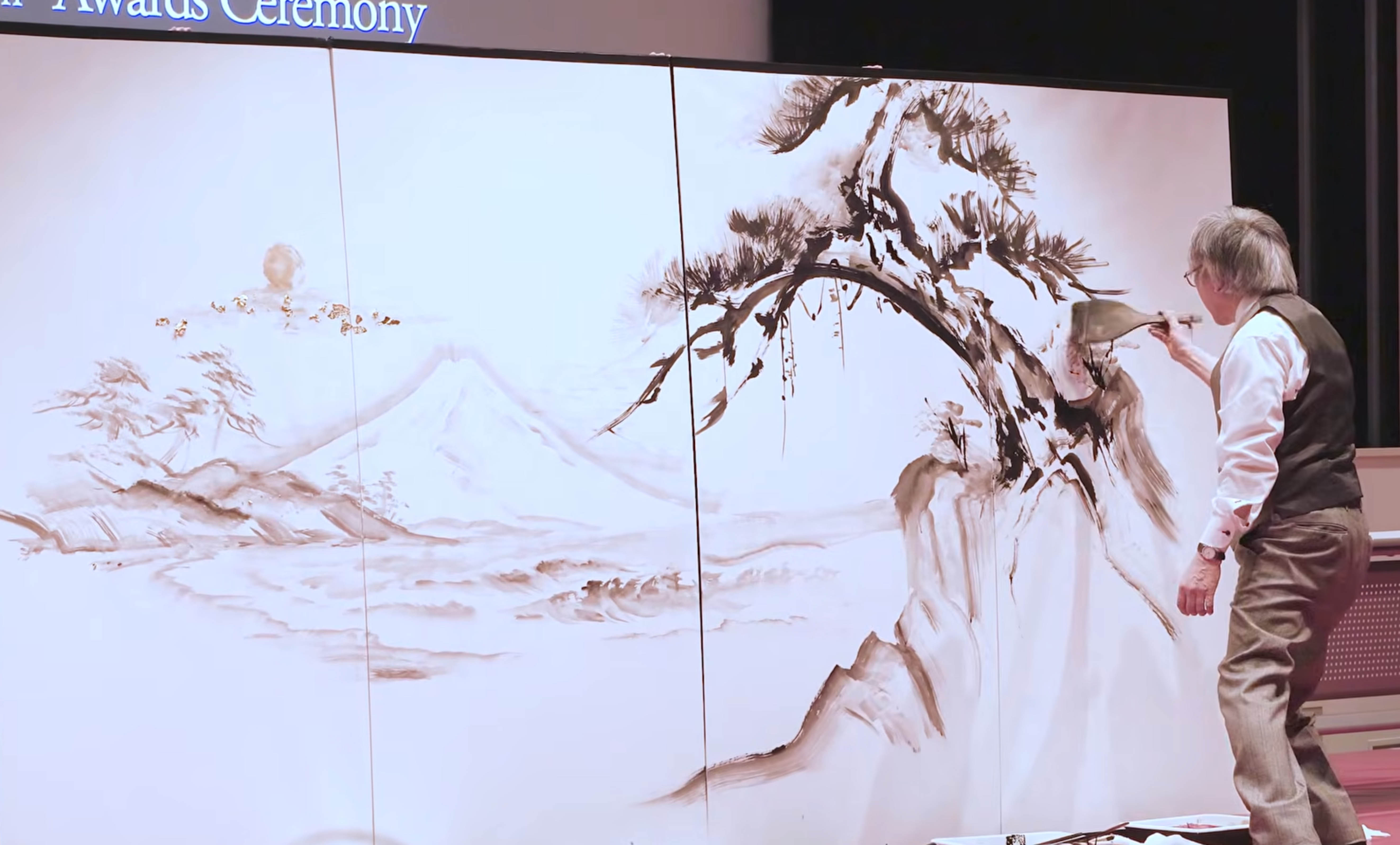
Art Beyond Boundaries 2026: Tohun Kobayashi's Live Sumi-e of Mount Fuji and Pine